REDG Insights
What Makes a Lead Qualified in Real Estate?
REDG Team · · 7 min read

What makes a lead qualified in real estate? Learn the seller signals, questions, and follow-up standards that protect your acquisition team's time each day.
A homeowner answering the phone is not a lead. A homeowner saying, “Send me an offer,” is not automatically a lead either. What makes a lead qualified is a verified combination of motivation, property fit, decision-making authority, realistic expectations, and a defined next step. Without those facts, your acquisition team is not working opportunities. They are sorting noise.
For wholesalers and investors, weak qualification creates expensive problems. Callers fill the CRM with vague notes. Acquisitions spends hours chasing people who were only curious. Follow-up gets buried under leads that were never actionable. The answer is not simply more dials. It is a tighter standard for what earns attention, follow-up capacity, and an acquisitions appointment.
What Makes a Lead Qualified for an Investor?
A qualified seller lead is a property owner with a real reason to sell, enough control to make a decision, and a situation your business can actually solve. The lead must also be willing to take a specific next step, whether that is sharing property details, reviewing a range, scheduling an appointment, or speaking with an acquisition manager.
Qualification is not a single yes-or-no question. It is an evidence-based process. A caller should leave the conversation with enough verified information for the next person to act intelligently. That means clear notes, accurate contact information, property condition details, seller timeline, price expectations, and the actual reason behind the sale.
The standard should match your buying criteria. A probate seller with no urgency may still be worth long-term nurture. A landlord with an occupied rental and a price far above market may be a poor cash-offer lead but a potential creative-finance conversation. Qualification does not mean forcing every seller into one box. It means assigning the right priority, strategy, and owner to every real opportunity.
Motivation must be specific
“Thinking about selling” is not motivation. It is an opening statement that needs to be tested.
A qualified conversation identifies the event or pressure driving the seller’s decision: inherited property, deferred maintenance, tenant issues, relocation, divorce, code violations, vacancy, mortgage pressure, a tired landlord situation, or a property they simply cannot manage anymore. The strongest leads can explain why selling matters now, not just someday.
Your caller should ask direct follow-up questions. What changed? What happens if the property does not sell in the next 30, 60, or 90 days? Have they listed it before? Are they considering repairs, a Realtor, or another investor? These answers reveal whether the homeowner has a real problem to solve or is only price shopping.
Motivation can change. A seller who is not ready this week may become highly motivated after a tenant leaves, a deadline approaches, or repairs become unavoidable. That is why proper notes and disciplined follow-up matter. A weak lead today is not a dead lead forever, but it should not consume immediate acquisition capacity.
Authority and decision-makers cannot be assumed
One of the most common qualification failures is treating the person on the phone as the sole decision-maker without confirming it. A property may be owned by spouses, siblings, an estate, an LLC, or a trust. The caller may be speaking to a tenant, family member, or one heir among several.
Confirm who is on title, who needs to approve a sale, and whether anyone else must join the next conversation. If the seller says, “I need to talk to my brother,” that is not a disqualifier. It is a workflow instruction. Record the brother’s role, get his contact information when appropriate, and schedule a time when all decision-makers can participate.
This protects your acquisition manager from repeating discovery calls and negotiating with someone who cannot commit. It also prevents a common pipeline illusion: a CRM full of “hot” leads where nobody has actual authority to move forward.
Condition reveals both value and urgency
Property condition is not just a comping detail. It often explains the seller’s pain, affects the offer strategy, and determines whether a cash offer is a fit.
A qualified lead should include more than “needs work.” Your team needs usable detail: roof age or known leaks, HVAC condition, foundation issues, water damage, electrical or plumbing concerns, kitchen and bath updates, occupancy status, and major repairs the owner has delayed. Ask what has been updated, what needs immediate attention, and whether there are photos available.
The goal is not to turn a cold caller into an inspector. The goal is to give acquisitions enough information to prepare for the conversation and avoid making blind assumptions. Accurate condition notes lead to better comps, cleaner offers, and fewer deals that fall apart after inspection.
Timeline turns interest into a working lead
A seller’s timeline tells you how to work the file. Someone who wants to sell this week requires immediate speed. Someone targeting spring may belong in a structured nurture campaign. Both can be qualified, but they cannot receive the same level of urgency.
Get a real date or a clear trigger whenever possible. “As soon as possible” should be clarified. Is that before the next mortgage payment? Before a job relocation? Before winter? Or does it simply mean the seller has not considered a deadline?
The best notes make the next action obvious: call back Friday after the seller speaks to their spouse, send a preliminary range after photos arrive, schedule an acquisition call Tuesday at 6 p.m., or place the lead into a 30-day follow-up sequence. A lead with no next step is usually just a conversation waiting to be lost.
Price Expectations Need Context, Not Judgment
Many teams disqualify homeowners too quickly because the asking price sounds unrealistic. That is a mistake. A high number can mean the seller is testing the market, reacting to a neighbor’s retail sale, paying off debt, or simply protecting themselves from a low offer.
The question is not whether the first number fits your formula. The question is whether there is room for a productive conversation. Ask how the seller arrived at the price, whether they have received other offers, what they need to net, and whether condition or convenience would affect their decision.
A seller asking retail for a fully renovated home may not fit a wholesale cash-buy model. A seller asking high because they need time, debt relief, or a solution for inherited belongings may be a candidate for a different structure. Good qualification captures the facts instead of labeling the seller “unmotivated” after one objection.
Build a Lead Score That Matches Your Operation
Not every qualified lead deserves an immediate call from your best closer. Your team needs tiers that create order in the pipeline.
A high-priority lead usually has clear motivation, direct decision-making authority, a near-term timeline, a property that fits your criteria, and a scheduled next step. These should move quickly to acquisitions, with complete notes and call recordings available for review.
A medium-priority lead has a credible reason to sell but a longer timeline, incomplete condition details, or a price gap that needs further discovery. These leads need scheduled follow-up, not neglect. A low-priority lead has vague motivation, no timeline, no authority, or no meaningful engagement. Keep the record clean, set a future touchpoint if warranted, and do not let it crowd out active opportunities.
The exact scoring model depends on your market and strategy. A landlord portfolio may prioritize occupancy and rent performance. A pre-foreclosure campaign may prioritize deadline dates and payoff information. The non-negotiable rule is consistency: every caller must use the same definitions, and every lead manager must know what happens next.
Qualification Fails When Handoffs Fail
Even a strong call becomes worthless when the handoff is weak. If the acquisition manager opens a record and sees “motivated, needs offer,” the caller did not qualify the lead. They created more work.
A complete handoff should state the seller’s reason for selling, target timeline, ownership and decision-maker status, property condition, price expectations, occupancy, previous listing or offer history, objections raised, and the agreed next action. It should also identify any missing information so acquisitions knows what to verify rather than guessing.
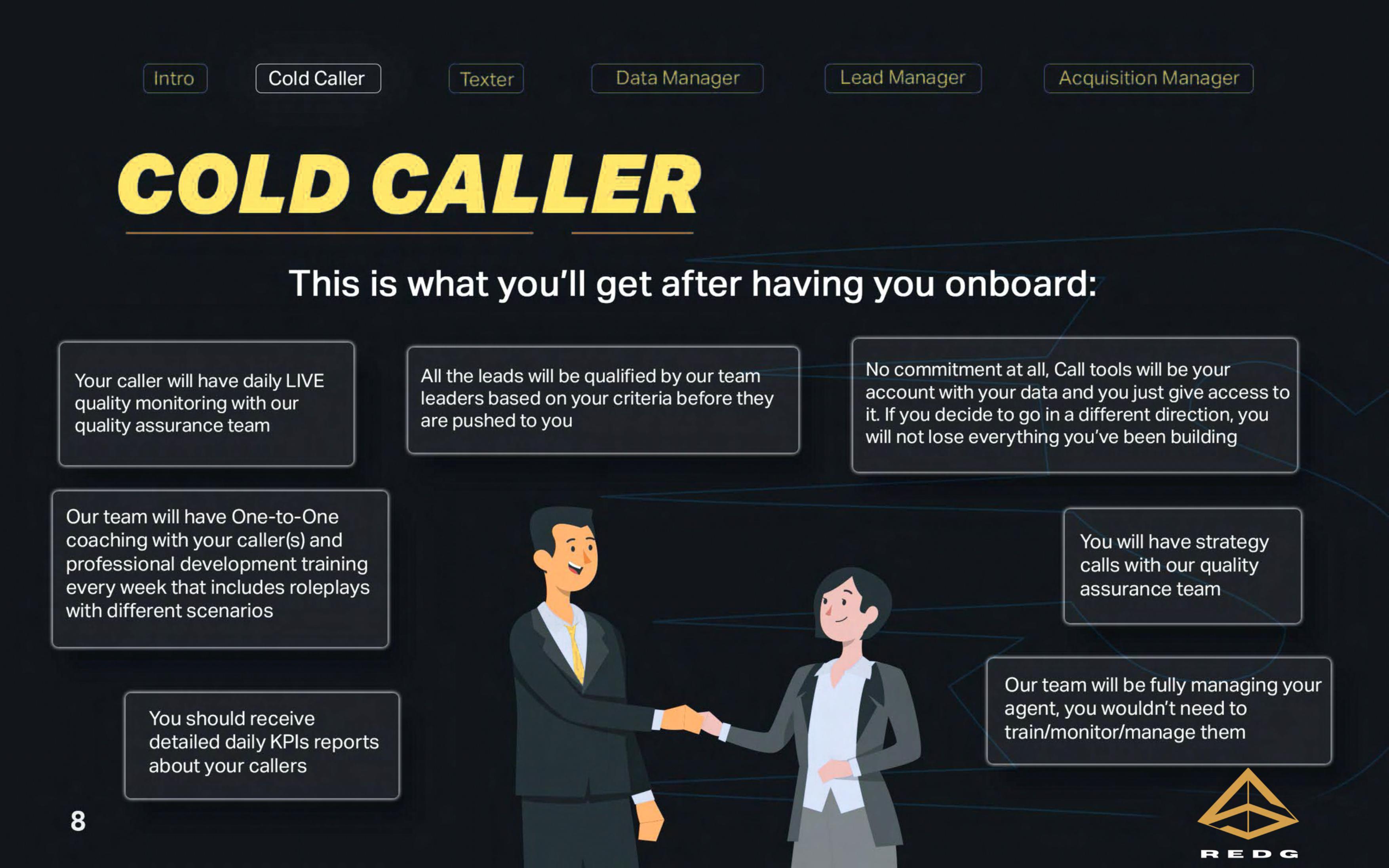
Speed matters after a seller commits to a conversation. But speed without context causes repeated questions, lower trust, and missed details. The right operation combines fast response with clean records. That is how REDG approaches acquisition support: trained real estate callers, measurable daily production, quality monitoring, and one accountable workflow from raw data to seller conversation.
Track the Signals That Prove Lead Quality
Appointment count alone does not prove quality. A caller can book plenty of appointments by setting vague expectations. The better measures are downstream: contact-to-qualified-lead rate, qualified-lead-to-appointment rate, appointment show rate, offer rate, contract rate, and the time from first conversation to acquisition follow-up.
Review recorded calls alongside these numbers. If a caller produces many leads but few meaningful appointments, the issue may be loose qualification. If appointments show but offers do not, your comping, offer strategy, or seller expectation-setting may need work. If sellers are qualified but go cold, follow-up speed and CRM discipline are likely the problem.
This is why quality control cannot be limited to counting calls. Production matters, but production without standards creates a larger pile of unworked data. Track the full path from connected call to contract opportunity.
A qualified lead is not the seller who says the right words. It is the seller whose situation has been clearly understood, accurately documented, and moved into the right next action. Set that standard, inspect it daily, and your acquisition team can spend more time solving real seller problems instead of chasing incomplete conversations.
Build your calling team
REDG recruits, trains, and manages Egyptian virtual assistants for real estate investors. Explore our real estate virtual assistants, wholesaling VAs, or listen to real calls.