REDG Insights
Real Estate Call Quality Monitoring That Performs
REDG Team · · 6 min read

Real estate call quality monitoring gives acquisition teams clear coaching, cleaner CRM data, stronger follow-up, and more qualified seller leads each day.
A caller can hit 250 connected conversations in a day and still damage your pipeline. If they miss motivation, mishandle a price objection, skip a timeline question, or fail to create the right follow-up task, that activity does not produce opportunities. It produces noise. Real estate call quality monitoring is how acquisition teams separate busy work from seller conversations that can become contracts.
For wholesalers, investors, and Realtors building off-market lead flow, monitoring is not about listening to calls for the sake of supervision. It is a production control. It shows whether your callers are protecting your data spend, representing your business correctly, and moving motivated sellers into the next defined action.
Why Activity Metrics Are Not Enough
Dial counts, connected calls, and talk time matter. They tell you whether a caller is working. They do not tell you whether the caller is effective.
A caller may sound friendly yet fail to ask why the owner would sell. They may receive a price and never clarify condition, decision-makers, mortgage status, or timeline. Another may identify a real lead but enter vague notes that force your acquisitions manager to call blind. Each failure slows the conversion path and makes marketing results look worse than they are.
The point is not to demand a perfect script. Homeowners do not speak in scripts, and the best conversations often move in unexpected directions. The goal is consistency around the information and actions that matter: qualification, objection handling, accurate notes, correct disposition, and reliable follow-up.
When monitored well, calls become evidence. You can see whether a low lead rate is caused by poor list quality, weak skip tracing, a caller issue, a bad offer position, or an unrealistic campaign expectation. Without that evidence, teams tend to replace lists, callers, or software based on guesswork.
What Real Estate Call Quality Monitoring Should Measure
A useful quality review starts with the full acquisition objective, not generic customer-service standards. Your team is not trying to create a pleasant call center experience. It is trying to identify seller intent and advance viable opportunities without burning trust.
Opening, Permission, and Property Confirmation
The first seconds determine whether the homeowner stays engaged. Review whether the caller identifies the correct property, explains the reason for the call clearly, and earns enough permission to continue. A confident, natural opening matters more than rigid wording.
The reviewer should also confirm that the caller respects clear opt-outs and does not pressure owners who are not interested. Compliance and brand protection are operational requirements, not side issues.
Motivation and Situation Discovery
A qualified lead is more than a homeowner who says they might sell. The caller needs to understand what changed, why the owner is considering a sale, and whether there is a problem your team can solve.
That may involve inherited property, landlord fatigue, code violations, deferred maintenance, a vacant house, divorce, relocation, probate, foreclosure pressure, or simply a desire for convenience. The key is whether the caller asks enough useful questions to uncover the real situation instead of jumping straight to price.
Timeline, Price, and Decision Process
The best callers connect urgency to a practical next step. They clarify timing, ask what the owner hopes to receive, identify other decision-makers, and understand whether the seller is speaking with other buyers.
Price is especially easy to mishandle. A caller should not argue with an owner’s number or make unsupported promises. They should acknowledge the expectation, gather details, and keep the conversation alive for a real evaluation. If the property requires comps or a closer review, that must be clear in the CRM record.
Objection Handling and Conversation Control
Objections are not automatic disqualifiers. “I’m not interested,” “I already have an agent,” and “Your offer will be too low” can mean the owner is truly unavailable. They can also mean the caller has not yet established relevance.
Quality monitoring should assess whether the caller listens, responds appropriately, and knows when to make one professional attempt to reframe the conversation. It should also identify when the caller becomes defensive, sounds transactional, or continues pushing after a firm no. The right balance protects the brand while giving genuine opportunities a chance to surface.
CRM Accuracy and Follow-Up Execution
A strong call that disappears into a weak CRM process has no value. Every reviewed conversation should be checked against the written record: correct property, motivation, timeline, condition details, asking price, contact preference, disposition, and next action.
This is where many teams lose revenue. A caller identifies a seller who needs to move in 60 days, but the lead is tagged as cold. Or the caller promises a callback Tuesday, yet no task is created. Monitoring must connect call performance to what happens after the call, not stop at the recording.
Build a Scorecard Your Team Will Actually Use
A scorecard should be specific enough to create consistent evaluations and simple enough to use daily. If it takes 20 minutes to score one call, it will become an abandoned management project.
Use weighted categories based on what creates deals in your market. A practical scorecard can evaluate opening and professionalism, property verification, motivation discovery, timeline and price discovery, objection handling, CRM notes, disposition accuracy, and next-step execution. Add a critical-error section for issues such as failure to honor an opt-out, inaccurate representation, missing a hot lead, or entering materially wrong data.
Not every call should receive the same standard. A wrong-number conversation cannot be graded like a warm inherited-property lead. Reviewers should select calls across outcomes: new leads, callbacks, not interested responses, objections, follow-ups, and calls that were marked dead. That mix exposes whether callers are only effective when an owner is easy to engage.
The scorecard also needs clear definitions. “Good notes” is too subjective. “Notes include motivation, timeline, condition, price expectation, decision-maker status, and scheduled next action when applicable” is measurable.
Turn Call Reviews Into Better Production
Monitoring fails when it becomes a weekly report nobody acts on. The best operating rhythm is fast, visible, and connected to coaching.
Review a manageable sample of calls per caller each day, then identify one or two behaviors to correct. A caller who asks excellent motivation questions but avoids price discussion does not need a lecture on every category. They need focused practice on transitioning to price without sounding aggressive.
Use short call clips during coaching. Let the caller hear the exact moment where they spoke over the owner, missed a cue, or failed to confirm the follow-up. Then role-play the correction immediately. General feedback such as “be more confident” rarely changes behavior. A precise correction does.
Track trends at the individual and campaign level. If one caller repeatedly misses timeline questions, coach the caller. If every caller gets the same “not interested” response from a list, investigate list age, source, contact data, market saturation, or the opening approach. Quality monitoring should reveal system problems as well as individual performance gaps.
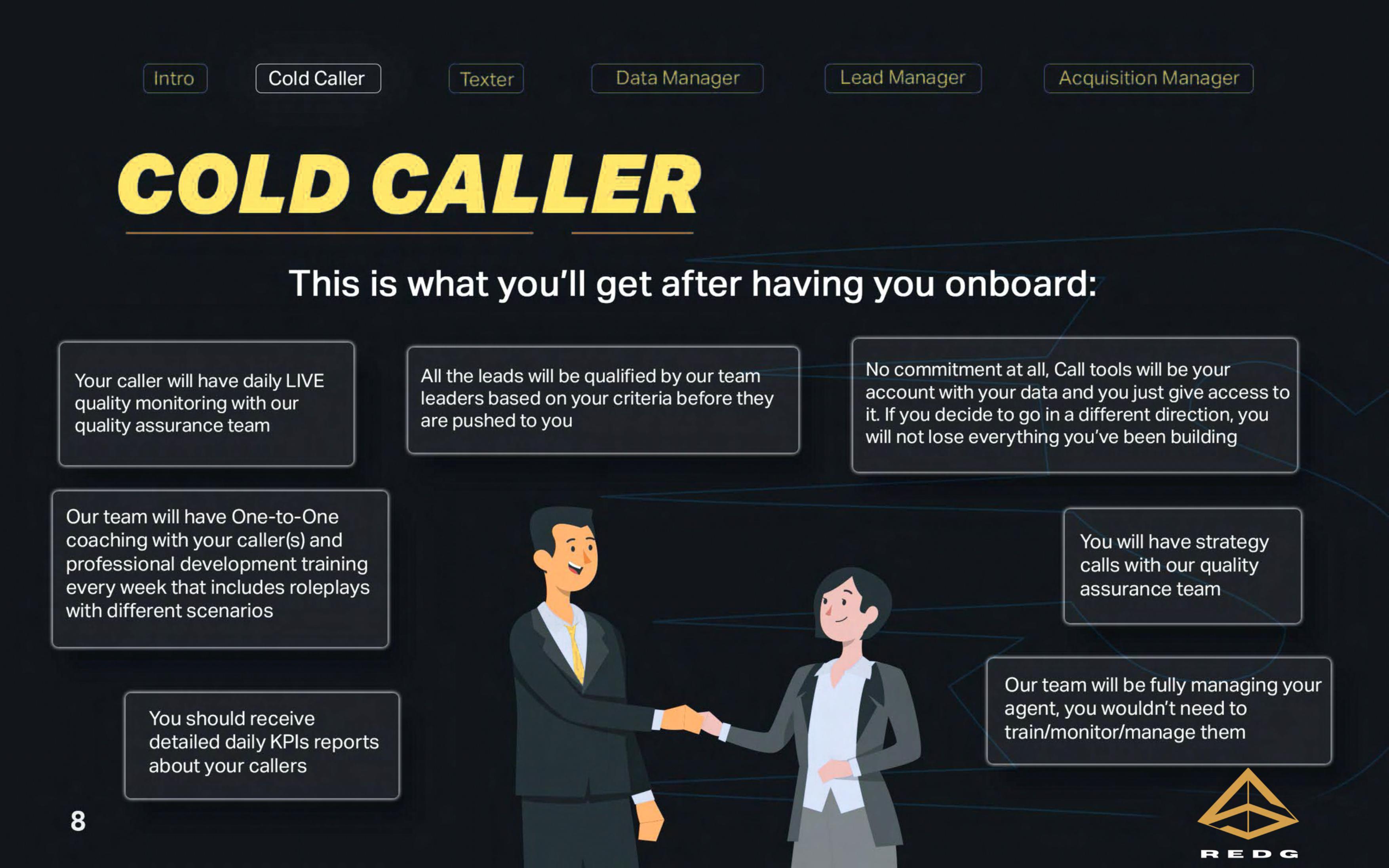
REDG uses this approach as part of managed acquisition support: calls, CRM actions, and pipeline movement are treated as one accountable production system rather than disconnected tasks.
Know Which Metrics Belong Together
Quality scores should never stand alone. A caller with a high quality score but too few connected conversations may be underproducing. A caller with massive volume and weak qualification can overload acquisitions with leads that go nowhere.
Look at quality alongside connected calls, contact rate, conversations per hour, lead rate, appointments or warm handoffs, follow-up completion, and downstream conversion. The right benchmark depends on your list, market, campaign type, and acquisition strategy. Pre-foreclosure outreach will not behave like absentee-owner outreach, and a creative-finance campaign requires different discovery questions than a cash-offer campaign.
The goal is not to force identical results from every list. It is to know why performance changed and what your team will do next.
The Cost of Waiting Until Lead Volume Drops
Most operators start reviewing calls after they notice the pipeline thinning. By that point, weak habits may have affected thousands of records and dozens of seller conversations.
Monitor early. A small pattern, such as callers failing to confirm property condition or lead managers missing promised callbacks, becomes expensive when repeated at scale. Early reviews protect your paid data, your calling hours, and the acquisition team’s calendar.
Strong real estate call quality monitoring does not make callers sound robotic. It gives them a clear standard, catches issues before they compound, and proves whether daily effort is becoming real opportunity. Your pipeline deserves more than activity reports. It deserves evidence that every conversation is being handled like a potential deal.
Build your calling team
REDG recruits, trains, and manages Egyptian virtual assistants for real estate investors. Explore our real estate virtual assistants, wholesaling VAs, or listen to real calls.