
Cold Calling
How to Hire and Manage Egyptian Cold Callers for Real Estate Wholesaling
REDG Team · January 22, 2025 · 14 min read
Hiring a remote cold caller can give a wholesaling business consistent prospecting capacity, but geography does not guarantee performance. Egyptian talent can be a strong fit for U.S. real estate campaigns when the hiring process tests spoken communication, listening, judgment, and reliability—and when the caller works inside a managed system. The goal is not to fill a cheap seat. It is to build a compliant, coachable front line that creates qualified seller conversations for acquisitions.
Define the role before you recruit
A caller cannot succeed in a role that changes every day. Decide whether the person is responsible only for first contact or also for follow-up, appointment setting, CRM updates, texting, list cleanup, and lead qualification. Define the target markets, property types, offer model, calling hours, escalation rules, and exact information required before a record can be submitted as a lead.
Write the scorecard before the job description. Include controllable activity, conversation quality, data accuracy, attendance, coachability, and qualified outcomes. This keeps recruiting focused on the work and prevents the team from choosing a candidate based only on a pleasant voice sample.
Screen for communication, listening, and judgment
Clear spoken English matters, but accent is only one small part of communication. The more important skills are comprehension, pace, empathy, pronunciation of local place names, active listening, and the ability to answer an unexpected question without freezing or becoming argumentative.
Use a live role-play rather than relying on a recorded introduction. Give the candidate a simple property scenario, interrupt them, raise an objection, and then ask them to summarize the seller's situation. A strong candidate listens for facts, stays composed, asks a relevant follow-up, and records accurate notes. A weak candidate races back to the script regardless of what the seller said.
- Ask for a live reading and an unscripted conversation.
- Test common U.S. names, street types, cities, numbers, and dates.
- Use role-plays for hostility, confusion, interest, and a clear opt-out.
- Have the candidate enter notes and choose a disposition after each call.
- Check schedule stability, internet reliability, backup power, and work environment.
Set up the campaign for lawful, respectful outreach
The investor or seller running the campaign remains responsible for how outreach is conducted. Before dialing, establish a written compliance process covering federal and state do-not-call rules, company-specific suppression requests, calling times, caller identification, dialer settings, recordkeeping, and any consent required for the technology or message type being used.
Do not ask a caller to make legal judgments during a live conversation. Give them clear instructions: how to identify the company and purpose, what claims they may make, how to handle a request not to be called, when to end the conversation, and where to escalate unusual situations. Counsel familiar with telemarketing and the target states should review the actual operation.
- Scrub lists using the compliance process approved for the campaign.
- Maintain a company-specific do-not-contact list and apply requests promptly.
- Use accurate caller identification and prohibit misleading statements.
- Match calling windows to the recipient's local time and applicable rules.
- Review dialer behavior, prerecorded content, and text follow-up separately.
Train the real estate conversation, not just the script
A script is a map, not a speech. The caller needs enough real estate context to understand what the homeowner means. Training should cover occupancy, property condition, liens, inherited property, foreclosure timing, tenants, asking price, decision-makers, and the company's actual purchase process. The caller does not need to be the closer, but they must recognize information that changes the value or urgency of the lead.
Teach a simple conversation structure: permission to continue, reason for the call, open question, listening, light qualification, next step, and accurate recap. Practice transitions rather than clever rebuttals. The purpose is to discover whether a conversation makes sense, not to win an argument with a homeowner who does not want to talk.
Define a qualified lead in writing
Teams waste hours when callers submit anyone who says maybe. A written lead standard might require the correct decision-maker, a confirmed property, openness to discussing a sale, and enough information about condition, motivation, timeline, and price to justify an acquisition call. The standard should reflect the investor's strategy and market, not a generic template.
Some fields can be unknown without disqualifying the lead. An inherited-property owner may not know the repair cost, and a tired landlord may avoid naming a price. Train callers to distinguish unknown from unwilling and to record the seller's exact language when it matters. Acquisition managers can then prepare for the conversation instead of starting from zero.
Build an onboarding plan for the first four weeks
Week one should cover the company, markets, offer process, compliance, tools, script, and disposition definitions. Use recorded examples and controlled role-plays before live dialing. Week two introduces live calls in shorter blocks with same-day review. Week three raises activity expectations while focusing coaching on one behavior at a time. Week four evaluates whether the caller can operate consistently without constant correction.
Do not confuse immediate activity with readiness. A poorly trained caller can damage a list in a few hours by mislabeling numbers, submitting weak leads, or mishandling opt-outs. A deliberate ramp protects the market and gives the manager evidence about whether the hire is coachable.
Measure a balanced caller scorecard
Raw dials are useful for capacity planning, but they are not a performance outcome. Dialer mode, list quality, call length, and connection rate can change the number dramatically. Review hours worked, attempts, connections, meaningful conversations, qualified leads, appointments, lead acceptance, follow-up completion, and data accuracy together.
Quality must sit beside quantity. Listen to a representative sample of calls across outcomes: qualified lead, not interested, wrong number, no motivation, difficult seller, and opt-out. Score opening clarity, listening, questions, tone, accuracy, compliance, disposition, and notes. A caller who generates many rejected leads is moving work downstream rather than creating value.
- Connection rate helps reveal list and calling-window quality.
- Meaningful-conversation rate shows whether connections become real discussions.
- Qualified-lead rate measures targeting and caller discovery.
- Lead acceptance tracks alignment between callers and acquisitions.
- Appointment show rate reveals expectation-setting and handoff quality.
- Data accuracy and compliance errors should be monitored independently of sales results.
Coach with call evidence
Daily check-ins should be short: attendance, system issues, yesterday's results, today's target, and one obstacle. Weekly coaching should use recordings and timestamps. Identify the exact sentence or missed question, demonstrate an alternative, role-play it, and listen for the change in the next call sample.
Separate skill problems from system problems. If every caller has a weak connection rate, investigate the list, phone data, dialing window, or carrier setup. If one caller has low conversation-to-lead conversion, review listening and qualification. Coaching works when the diagnosis points to something the person can change.
Protect the handoff between callers and acquisitions
The caller and closer should agree on what happens after a lead is submitted. The lead record needs a concise summary, all qualification fields, the seller's preferred contact time, and a link to the recording when permitted. The acquisition manager should accept, reject with a reason, or request more information within an agreed window.
Review rejection reasons every week. If callers repeatedly miss the same requirement, retrain the standard. If acquisitions rejects leads inconsistently, clarify the buying criteria. This feedback loop is where an outsourced calling team becomes integrated with the business instead of operating as a separate vendor.
Retention comes from management, not perks alone
Reliable remote callers stay when expectations are stable, pay is timely, performance is recognized, and coaching helps them improve. Create progression from caller to senior caller, quality reviewer, trainer, or team lead. Document processes so advancement does not depend on informal favoritism.
Respect local holidays, time-zone realities, and the strain of working U.S. hours from Egypt. Plan coverage instead of treating predictable scheduling needs as surprises. Strong retention protects the market knowledge and objection-handling skill that take months to build.
Agency, direct hire, or managed team?
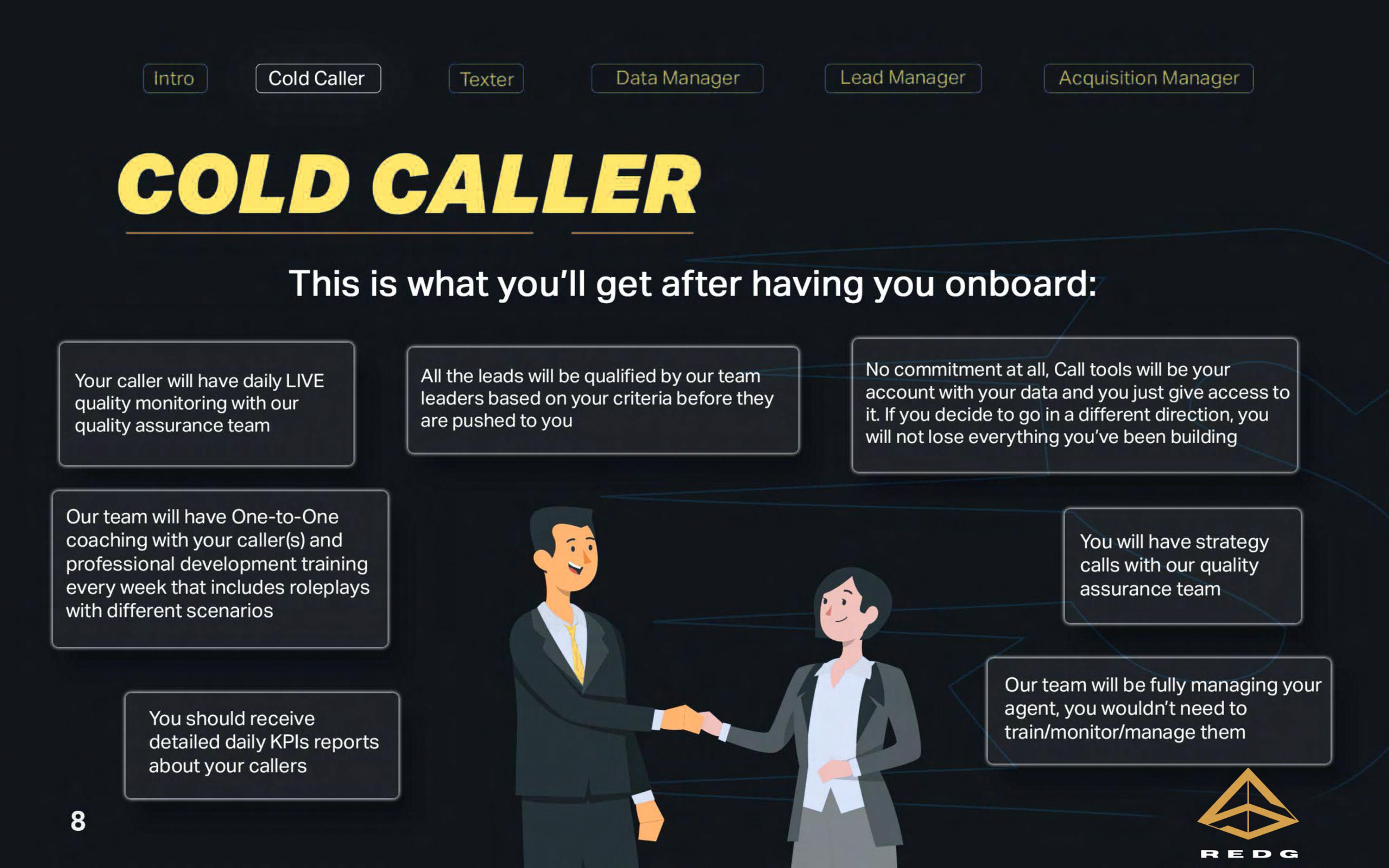
A direct hire offers more control but requires the investor to recruit, train, supervise, cover absences, manage quality, and maintain the operating system. A staffing agency can reduce recruiting work but may still leave day-to-day management with the client. A managed team should provide supervision, reporting, coaching, quality review, and replacement coverage in addition to the caller.
Evaluate the operating model, not just the hourly price. Ask who owns training, who reviews recordings, how lead quality is defined, what reporting is visible, how data is protected, how compliance instructions are implemented, and what happens when performance drops. The cheapest seat becomes expensive when the acquisitions team spends every afternoon fixing its work.
The takeaway
Egypt can be an excellent source of real estate calling talent, but results come from role clarity, live screening, lawful campaign design, real estate training, balanced measurement, evidence-based coaching, and a tight feedback loop with acquisitions.
Sources & further reading
Regulations vary by campaign and location. Review current official guidance and consult qualified counsel before outreach.