
Wholesaling
Real Estate Wholesaling VA: Building an Outbound Team That Produces Contracts
REDG Team · September 20, 2026 · 12 min read
Wholesaling is a volume business disguised as a negotiation business. The contracts come from conversations, the conversations come from dials, and the dials only matter if the data underneath them is clean. A wholesaling virtual assistant team exists to keep that machine running every day so the operator can spend their hours on offers and closings.
The three seats that make the system work
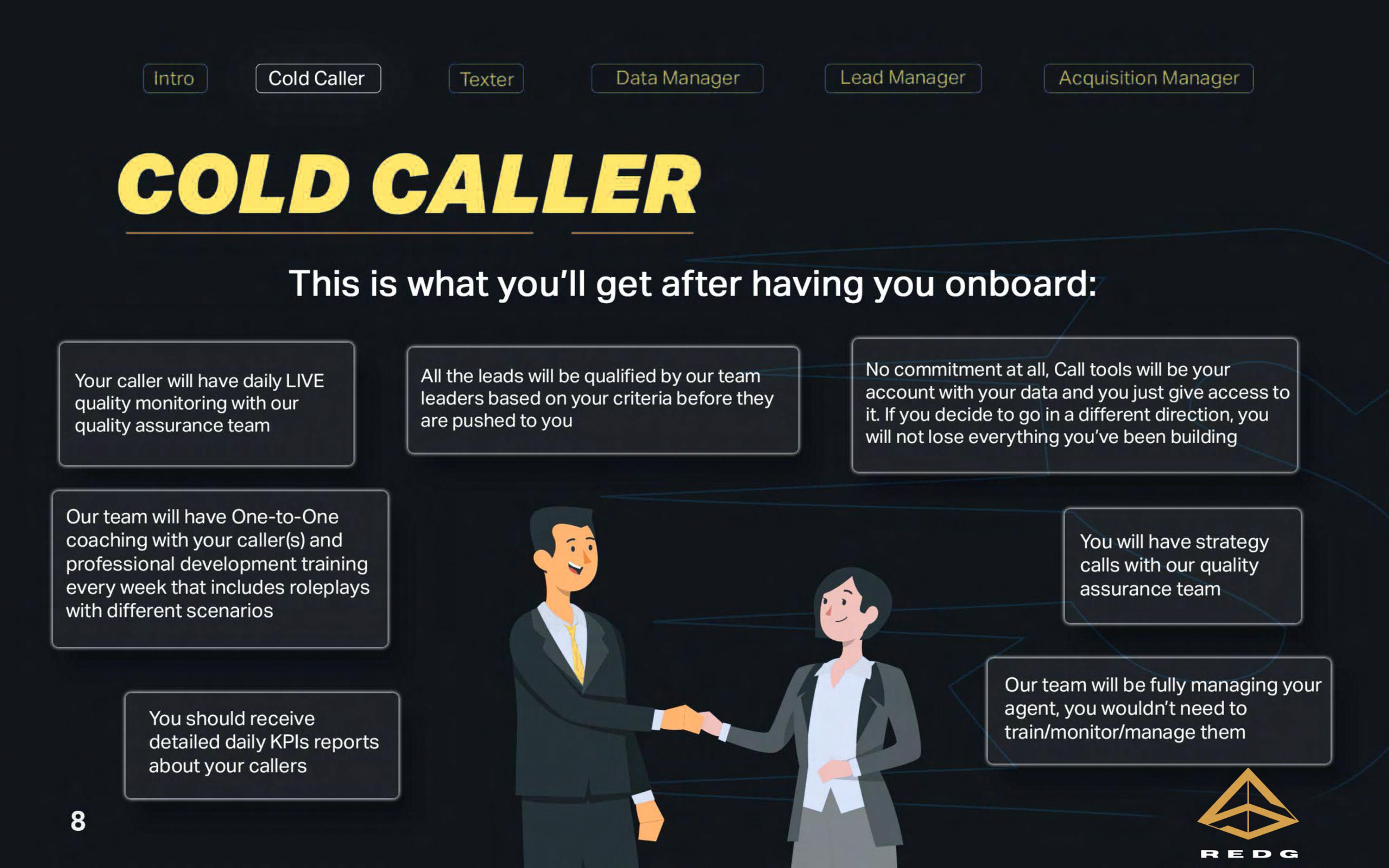
A functioning wholesaling outbound operation needs three distinct jobs, even if you start by staffing one. The data manager prepares the lists. The cold caller works them daily. The lead manager keeps every warm lead alive until it becomes an appointment or a clear no.
Operators who hire a caller first and skip the data seat almost always plateau. A caller working a bad list burns hours on disconnected numbers and wrong parties, and the daily numbers look like a performance problem when they are a data problem.
- Data manager — pulls, stacks, dedupes, skip-traces, and tags lists.
- Cold caller — works the list daily on your script and dialer.
- Lead manager — runs follow-up cadences and sets appointments.
- Acquisitions support — comps, offer prep, and contract coordination.
Realistic production numbers
With clean, skip-traced data and a power dialer, a trained caller typically produces several hundred to roughly a thousand dials per day, converting into a modest number of real conversations and a small handful of qualified leads. Those ranges swing widely with list quality, market, and time of year.
Track the ratios rather than the raw totals. Dials per conversation tells you about data quality. Conversations per qualified lead tells you about the script and the caller. Qualified leads per contract tells you about your acquisitions process. Each ratio points at a different fix.
Define a qualified lead before you staff the seat
The single most common failure in offshore outbound is an undefined handoff. The caller thinks they passed a lead; the acquisitions manager thinks they received noise. Write the definition down and hold both sides to it.
A workable standard covers four points: confirmed decision-maker, property you can actually transact on, a stated reason to consider selling, and a timeline. Anything short of that goes back into the follow-up cadence rather than onto the closer's calendar.
- Confirmed owner or authorized decision-maker on the call.
- Property type, condition, and occupancy captured in the seller's words.
- A genuine motivation, not a polite maybe.
- A timeline and an agreed next step with a date.
Exit strategies change the script
Wholesaling, subject-to, novations, and creative financing require different questions on the call. A caller working a creative-finance strategy needs to surface loan status, payment comfort, and whether the seller is open to structure — questions that are irrelevant on a straight cash-offer campaign.
Decide your primary exit strategy before writing the script, and give the caller a single decision tree rather than four. Complexity on a live call produces hesitation, and hesitation loses sellers.
KPIs to review every week
Daily reporting keeps the seat honest; weekly review makes it better. Review one strong call and one weak call with the caller each week, and look at trends rather than single days.
If the dials are there and the conversations are not, look at the data. If conversations are there and leads are not, look at the script and the qualification. If leads are there and contracts are not, the problem has moved to acquisitions.
- Delivered calling hours versus scheduled hours.
- Dials, conversations, and qualified leads per day.
- Follow-up cadence completion rate on warm leads.
- Appointment show rate and contracts per qualified lead.
Compliance before volume
Outbound calling is governed by federal and state rules, carrier policy, and the dialing technology used. The operator running the campaign is responsible for scrubbing, calling windows in the recipient's local time, truthful identification, recording disclosures where required, and permanent suppression of do-not-contact requests.
Give callers fixed instructions instead of judgment calls, and audit the recordings. This article is operational guidance, not legal advice — have qualified counsel review your lists, scripts, dialer configuration, and target states.
The takeaway
Staff data, calling, and follow-up as separate jobs, define a qualified lead in writing, and manage the ratios rather than the raw dial count. That is what turns an outbound team into a contract pipeline.
Sources & further reading
Regulations vary by campaign and location. Review current official guidance and consult qualified counsel before outreach.