REDG Insights
How to Recycle Real Estate Leads That Go Cold
REDG Team · · 6 min read

Learn how to recycle real estate leads with disciplined follow-up, clean CRM stages, and multi-channel outreach that turns old records into deals again.
A seller who said “call me in six months” is not a dead lead. Neither is the owner who stopped answering after a price conversation, the inherited-property contact who needed time to sort probate, or the landlord waiting for a tenant to move out. Those records become wasted marketing spend only when your team has no system for returning to them. Knowing how to recycle real estate leads means turning yesterday’s conversations into a controlled follow-up pipeline, not blasting an old list and hoping for a callback.
For wholesalers, investors, and acquisition teams, recycled leads are often cheaper to convert than newly sourced data. You already paid for the list, skip tracing, calls, texts, and initial qualification. The owner has heard your name before. The work now is to re-enter the conversation with timing, context, and a clear next step.
How to Recycle Real Estate Leads Without Wasting Time
Lead recycling starts with a hard truth: “not now” does not mean one thing. A homeowner may be unmotivated, but they may also be dealing with a lease expiration, family decision, listing agreement, title issue, relocation date, or unrealistic price expectation. If every old record sits in one generic “follow-up” bucket, your team cannot prioritize correctly.
Pull leads that have had a real interaction, not every disconnected dial or bad number in your CRM. Start with prior conversations that included seller intent, property details, a stated timeline, or an objection that could change. Then organize each lead by the reason the deal did not move forward.
Useful recycle segments include leads that needed more time, sellers who wanted a higher price, owners who stopped responding after engagement, landlords with occupancy issues, inherited-property contacts, and leads lost because the property was not a fit at the time. Also separate leads that previously chose an agent or another buyer. They may return to the market, but they require a different conversation and a careful review of any current representation.
The goal is not to treat every old lead as hot. The goal is to identify which conditions may have changed and assign the right level of follow-up.
Clean the Record Before You Call
A recycle campaign fails when the caller opens a record with no usable history. Before outreach begins, verify phone numbers where possible, review call notes, confirm property ownership, and check whether the property appears to be listed, transferred, or otherwise no longer relevant.
Every record should answer a few operational questions: When was the last meaningful contact? Why did the seller not move forward? What price or terms did they discuss? What was their stated timeline? What happened on the last follow-up attempt?
Do not ask a seller to repeat information your team already collected. It signals that your operation is disorganized and gives the owner a reason to disengage. A lead manager should make the CRM record useful before a caller spends another dial on it.
Build a Recycle Cadence Around Seller Timing
Random follow-up is not a strategy. A seller who said “call after the holidays” needs a different cadence than an owner who wanted $40,000 above your offer or a landlord whose lease ends next quarter.
Set the next action based on the trigger, not just a generic 30-day reminder. If a seller cited a specific event, schedule contact before and after that event. For example, a homeowner waiting for an adult child to relocate may need a check-in two weeks before the expected move and another immediately after. A landlord waiting for a tenant vacancy should be contacted near the lease-end date, not every week until they block your number.
For less-defined situations, use a measured multi-channel sequence. A call can reopen the relationship; a text can make it easy to respond; a brief voicemail can provide context when they are unavailable. The message should acknowledge the prior conversation and give the seller a reason to answer now.
Instead of saying, “Are you still looking to sell?” use the reason they gave you: “When we spoke, you were considering selling after your tenant moved out. Has that timeline changed?” That is more credible, more relevant, and far more likely to produce a useful answer.
Frequency depends on lead quality and seller behavior. A motivated prospect who went quiet after discussing terms deserves persistent, thoughtful outreach. A clearly uninterested owner who repeatedly asks not to be contacted does not. Respect opt-outs, internal do-not-call procedures, and applicable calling and texting rules. Volume never fixes poor targeting or poor compliance.
Requalify the Lead, Not Just the Phone Number
A recycled lead is not simply a callback. It is a new qualification event. The condition of the property may have changed. The owner’s urgency may have increased or disappeared. Their price expectation may now be realistic, or it may be even further from the market.
When you reconnect, confirm the core acquisition facts: ownership, property condition, occupancy, timeline, price expectation, decision-makers, and the problem they are trying to solve. Then compare the new information against the original record.
This is where weak callers lose deals. They hear, “I might sell,” mark the lead as warm, and send it to acquisitions with no timeline, no motivation, and no meaningful detail. That is activity without production.
A qualified recycled lead should give the acquisitions team a reason to act. Maybe the seller’s listing expired. Maybe the property is now vacant. Maybe a family member has agreed to sell. Maybe the owner finally understands the repair cost after receiving contractor bids. Capture the change that created the opportunity.
Handle Old Objections With New Information
The seller who wanted more money is not necessarily a bad lead. Their objection may have been based on a neighbor’s sale, a retail listing estimate, or an emotional attachment to the property. Reopening that conversation requires discipline.
Do not argue with the old number. Ask what has changed since you last spoke, then establish whether their expectation is still fixed. If the property needs work, the seller has holding costs, or their desired timeline has tightened, a fresh conversation about price and terms may be productive.
For creative deals, recycled leads can be especially valuable. An owner who would not accept a cash offer six months ago may now be open to seller financing, a subject-to structure, a novation, or a flexible close. Those options only matter when the lead manager captures the seller’s real priorities and routes the conversation to an acquisitions professional who can structure the right solution.
Make CRM Stages Enforceable
Your CRM should tell the team what happens next without requiring guesswork. “Follow-up” is not a stage. It is an instruction with no deadline, no owner, and no definition of success.
Build distinct stages such as nurture, recycle-ready, active recycle, requalified, acquisition review, and long-term hold. Each stage needs a required next action, due date, assigned owner, and disposition rule. If a caller reaches a seller and learns that the property sold, the record should be closed accurately. If the seller asks for a call next month, that follow-up should be scheduled before the call ends.
Track more than dials. A recycle campaign should report contact rate, conversations, requalification rate, appointments or acquisition handoffs, offers made, contracts, and conversion by lead source and segment. Those numbers reveal whether the issue is bad data, weak messaging, caller performance, or poor follow-up after the handoff.
A disciplined team also reviews call recordings and notes. If callers repeatedly fail to reference prior conversations, miss motivation signals, or leave vague dispositions, the problem is operational. Fix it before adding more leads to the campaign.
Assign Clear Ownership From First Dial to Offer
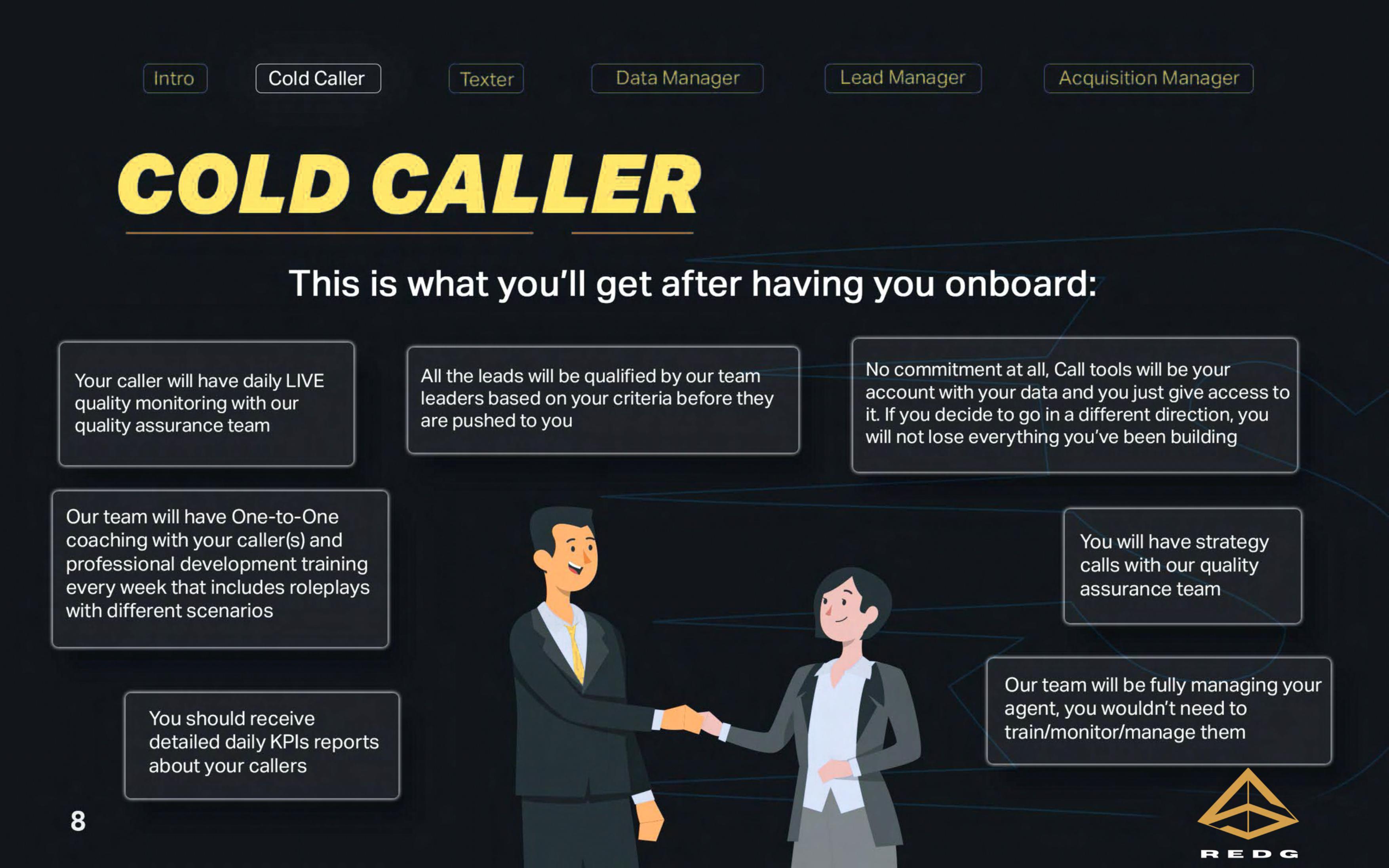
Lead recycling breaks down at handoffs. The cold caller reaches the seller, the lead manager does not review the notes, acquisitions receives incomplete information, and the seller waits days for a callback. By the time someone responds, the moment has passed.
Set service-level expectations for every handoff. A requalified seller with urgency should move to acquisitions quickly. A lead with a future trigger should return to the correct nurture workflow with a verified follow-up date. A data issue should be routed for correction, not left in circulation.
This is why an acquisition operation needs one accountable team across data, outreach, lead management, and negotiation. REDG-style production standards are not about filling seats. They are about making sure every seller conversation creates a documented next action and every next action gets completed.
Old leads do not need more hope. They need better records, better timing, and consistent human follow-up. Pull a focused segment this week, review the call history, assign ownership, and measure what happens after the conversation. The next deal may already be sitting in your CRM, waiting for your team to act like it matters.
Build your calling team
REDG recruits, trains, and manages Egyptian virtual assistants for real estate investors. Explore our real estate virtual assistants, wholesaling VAs, or listen to real calls.