REDG Insights
How to Qualify Motivated Sellers Before You Chase Them
REDG Team · · 7 min read

Learn how to qualify motivated sellers with a repeatable call framework that separates real urgency from weak leads and protects acquisition time daily.
A homeowner says, “Make me an offer,” and your caller marks the lead hot. Three days later, the seller will not provide a price, cannot explain their timeline, and is still waiting for a retail listing agent to call them back. That is not a motivated seller. It is an unqualified conversation that can drain your acquisitions team’s calendar.
Knowing how to qualify motivated sellers means separating interest from intent. A seller does not become qualified because they answered the phone, dislike their property, or asked what you would pay. They become qualified when their situation, urgency, decision-making authority, property condition, price expectations, and willingness to take action line up.
For wholesalers and investors, qualification is where marketing spend becomes pipeline discipline. Get it right and your acquisition managers spend more time negotiating real opportunities. Get it wrong and they chase vague stories, stale CRM notes, and leads that were never ready to move.
Start With Motivation, Not Property Details
Property details matter, but they should not be the first thing your caller tries to collect. If the homeowner has no reason to sell, a perfect bed-and-bath count does not create a deal.
Start with a direct, natural question: “What has you considering selling the property?” Then stop talking. The answer reveals whether there is a real problem to solve or just casual curiosity.
Strong motivation usually has a specific event behind it: inherited property, deferred maintenance, tenant trouble, divorce, relocation, financial pressure, a vacant house, or an estate timeline. The event itself is not enough. Your caller needs to understand the impact. A landlord dealing with one late-paying tenant may not be motivated. A landlord who lives out of state, has repeated evictions, and wants the property off their hands before another vacancy is different.
Do not force a seller to disclose private details. The goal is not to interrogate them. The goal is to identify the practical reason a sale matters now and whether your offer structure can solve it.
Qualify Motivated Sellers With Five Non-Negotiables
A productive seller conversation should produce clear answers in five areas. If the caller cannot document these points, the lead is not ready for a handoff, regardless of how friendly the conversation felt.
- Reason for selling: What changed, and why is selling preferable to keeping, repairing, renting, or listing the property?
- Timeline: When does the seller realistically need or want to close? “Soon” is not a timeline. Ask what needs to happen and by when.
- Decision-makers: Does the person on the phone own the property and have authority to sell? Are there spouses, heirs, partners, trustees, or attorneys involved?
- Condition and access: What repairs are needed, what has been updated, and can the property be viewed? Condition affects both valuation and the seller’s likely fit for an as-is offer.
- Price and expectations: What amount would make selling worthwhile? If they refuse to name a number, find out how they plan to decide whether an offer works.
These five points are connected. A seller with a two-week relocation deadline, a vacant inherited house, full authority to sell, and realistic expectations may deserve immediate acquisition attention. A seller who “might sell someday” for an above-retail number does not, even if the property is in a strong market.
Ask Questions That Produce Usable Answers
Weak qualification comes from weak questions. “Are you motivated?” invites an automatic no, or a vague yes that tells you nothing. Open-ended questions get the story. Focused follow-ups get the facts your team needs to act.
After the initial reason for selling, a caller can ask, “What would you like to see happen with the property?” If the seller says they want a quick, simple sale, follow with, “What makes speed and simplicity more valuable than putting it on the market?” This clarifies whether they understand the trade-off between convenience and a retail price.
For timing, ask, “If you found an offer that worked, when would you want to be finished with the property?” If they say 30 days, ask what is driving that date. A deadline tied to a job move, probate milestone, tax issue, or tenant departure is more reliable than an arbitrary date.
Price needs the same discipline. Do not let callers accept “just make an offer” as the end of the discussion. A better response is: “We can review the property and make an offer, but so we do not waste your time, what range did you have in mind?” If they remain unwilling to discuss price, document that clearly and uncover their basis for value. Are they comparing the home to renovated retail listings? Did an agent suggest a figure? Do they have a payoff that must be covered?
The goal is not to pressure a number out of every seller. It is to identify the gap between their expectations and the type of transaction you can offer.
Verify Authority Before Booking an Appointment
One of the most expensive mistakes in acquisition is treating the first person who answers as the decision-maker. A lead can sound urgent and still be impossible to close because a sibling, spouse, co-owner, executor, or lender has not been included.
Ask ownership questions early and plainly: “Is the property in your name alone?” and “Will anyone else need to agree before you can sell?” If there are additional parties, determine who they are, whether they are aligned, and how they should be included in the next conversation.
This is especially critical with inherited properties. The person handling cleanout or maintenance may not be the executor. The executor may have authority but need agreement from heirs. A caller should never guess. The CRM needs a decision-maker map, not a vague note that says “talked to owner.”
Separate Lead Status From Lead Temperature
A lead can be warm without being qualified. It can be qualified but not ready this week. Your pipeline needs statuses that reflect reality, not enthusiasm.
A practical system uses clear disposition standards. A hot lead has verified motivation, a defined near-term timeline, reachable decision-makers, workable expectations, and a committed next step. A nurture lead has a real reason to sell but a longer timeline, unresolved family issue, or price gap that requires follow-up. A cold lead has no identifiable motivation, no timeline, or expectations far outside any reasonable buying strategy.
The key is that every status triggers an action. Hot leads go to an acquisition manager with complete notes and a scheduled appointment or call. Nurture leads get a specific follow-up date and reason. Cold leads return to the appropriate long-term campaign without clogging the active acquisitions queue.
A vague “follow up later” is not a workflow. It is a missed lead waiting to happen.
Build the Follow-Up Around the Seller’s Trigger
Most motivated sellers do not sign on the first call. They need time to talk with family, clear belongings, compare options, or work through the emotional weight of selling a home. That does not mean the lead is weak. It means your follow-up needs context.
Every follow-up task should state what changed, what the seller cares about, and what must be confirmed next. For example: “Call Thursday after probate attorney meeting. Seller wants an as-is sale before winter, sister must approve, expects around $210,000.” That note gives the next caller a reason to call and prevents the seller from repeating their story.
Timing matters. If a seller says they are meeting an agent Friday, call before the appointment to clarify their decision criteria, then follow up afterward. If a tenant is moving out at month-end, contact them when the vacancy becomes real. Generic check-ins lose to calls tied to the actual event.
Protect Quality With Call Reviews and KPI Standards
Qualification is not just a script issue. It is a management issue. Callers need a defined standard for what counts as a qualified lead, what must be entered in the CRM, and when an acquisition manager should receive a handoff.
Review recordings for more than call volume. Did the caller ask about the seller’s reason, timeline, authority, condition, price, and next step? Did they handle objections without sounding scripted? Did their notes accurately reflect the conversation? A high-volume caller who sends weak leads creates more operational damage than a lower-volume caller who consistently delivers complete opportunities.
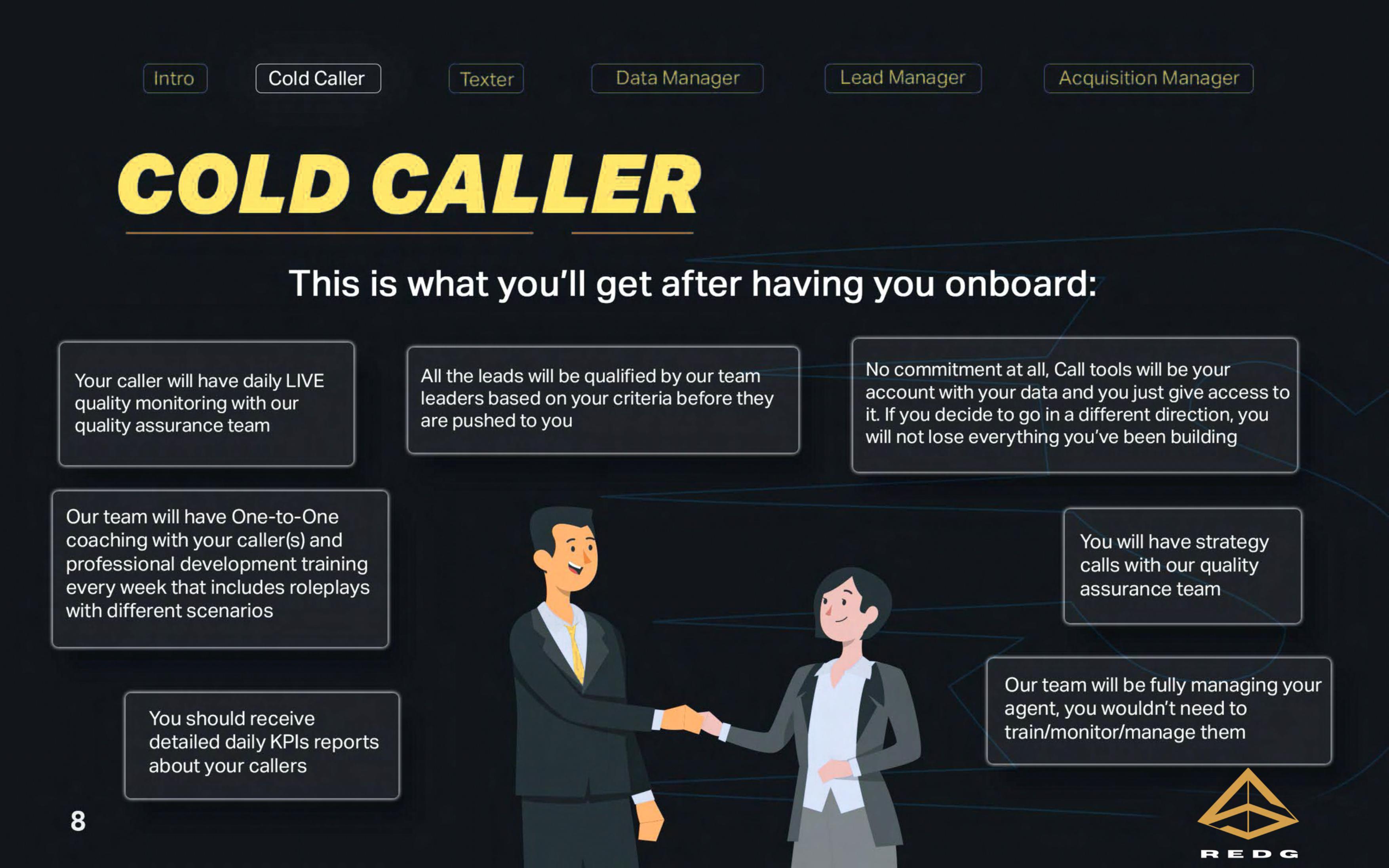
At REDG, this is why caller production is paired with live quality monitoring, recorded-call review, and structured pipeline actions. The standard is proof, not promises: conversations must create actionable data, not just activity counts.
Make Qualification a Handoff Standard
Your acquisition manager should not have to rediscover the seller’s story from scratch. Before a lead is handed off, the caller should be able to answer a simple question: why would this seller take the next step now?
If the answer includes a real problem, a believable timeline, the right people, a property that fits your buying criteria, and a defined next action, move with urgency. If it does not, keep the lead in the correct follow-up lane and continue building trust.
The best qualification process does not chase every conversation. It gives your team the confidence to pursue the right ones hard, while staying organized enough to be ready when the rest become real.
Build your calling team
REDG recruits, trains, and manages Egyptian virtual assistants for real estate investors. Explore our real estate virtual assistants, wholesaling VAs, or listen to real calls.