REDG Insights
How Acquisition CRM Software Stops Lead Leakage
REDG Team · · 6 min read

Acquisition CRM software keeps seller leads moving from first call to follow-up, negotiation, and contracts with measurable daily team accountability.
A lead says, “Call me after the holidays.” Your cold caller logs the note. Then nothing happens for six weeks.
That is not a lead-quality problem. It is an operations problem. Acquisition CRM software gives your team one place to track seller conversations, schedule the next action, assign ownership, and prove whether follow-up actually happened. For wholesalers and investors working off-market leads, that discipline is where more contracts come from.
The software itself will not create motivated sellers. It will not make a weak caller sound credible or turn bad skip-traced data into a good phone number. But when the right system supports a managed acquisition process, it stops good opportunities from disappearing between the first conversation and the offer.
Acquisition CRM Software Is a Production System
Most investors do not need another place to store contacts. They need a system that tells the team what must happen next.
A true acquisition workflow begins before the first dial. Lists are pulled, filtered, skip traced, and tagged by market, lead source, property type, campaign, and seller profile. Once outreach starts, every disposition matters: wrong number, no answer, not interested, warm lead, active motivation, appointment, offer follow-up, or contract opportunity.
Without consistent dispositions, reporting becomes fiction. You cannot tell whether a campaign failed because the list was weak, the data was poor, the caller did not work enough records, or the follow-up team missed motivated sellers. Acquisition CRM software creates the record. Your operating standards determine whether that record is useful.
The key question is simple: can you open a seller record and immediately see the last conversation, the motivation, the property details, the objection, the next task, and the person responsible? If not, your pipeline is relying on memory, scattered texts, and individual effort. That does not scale.
What the CRM Must Control
A real estate acquisition CRM should control the handoffs that cost you deals. That means tracking activity from raw data through contract-ready opportunities, not merely collecting names and phone numbers.
Lead source and list accountability
Every record needs a clear origin. Was it an absentee-owner list, pre-foreclosure data, inherited property, high-equity owner, cold call campaign, inbound form, or SMS response? The source should remain attached to the lead through the entire process.
This matters when you review cost per conversation, cost per qualified lead, appointment rate, offer rate, and contract rate. If all leads get dumped into one generic bucket, you cannot identify where your marketing dollars are actually producing opportunities.
Call notes that an acquisition manager can use
“Motivated” is not a useful note by itself. A qualified seller record should capture why they may sell, their timeline, property condition, price expectations, occupancy status, mortgage situation when relevant, decision-makers, and the stated objection.
Notes must be written for the next person, not for the person who made the call. If your acquisition manager has to replay a recording or ask the caller what happened, the system is already slowing down the lead.
Follow-up tasks with deadlines
The money is usually in the follow-up. A seller who refuses an offer in March may accept a different conversation in June after a tenant moves out, a probate issue progresses, or a listing attempt fails.
Every meaningful contact needs a next action and a due date. “Follow up later” is not a workflow. “Call Thursday at 5:30 PM to discuss the vacant property after seller speaks with her brother” is a workflow.
The CRM should surface overdue tasks, show untouched leads, and make it obvious who owns each follow-up. If no one owns it, no one is accountable for it.
Stage definitions that mean something
Teams often create too many pipeline stages, then use them inconsistently. Keep the stages tied to actual decisions and actions. For example, a lead may move from new record to contacted, qualified, nurture, appointment, offer sent, negotiation, and contract.
The exact labels can vary by business model. A Realtor pursuing listings needs different milestones than a wholesaler pursuing cash offers or a creative-finance investor working subject-to terms. What cannot vary is the definition of each stage. Your team should know exactly what information and action are required before moving a seller forward.
The CRM Cannot Fix a Weak Front End
This is where many operators waste time and money. They buy software, import 20,000 records, connect a dialer, and assume the system will produce deals. Then the calling is inconsistent, the English fluency is weak, notes are thin, and qualified leads sit untouched.
Software exposes process gaps. It does not solve them.
Your caller needs a clear qualification framework and the confidence to handle common objections without sounding scripted. Your data manager needs standards for list pulling, deduplication, skip tracing, and campaign setup. Your lead manager needs a daily process for reviewing hot leads, assigning tasks, monitoring overdue follow-up, and escalating opportunities to acquisitions.
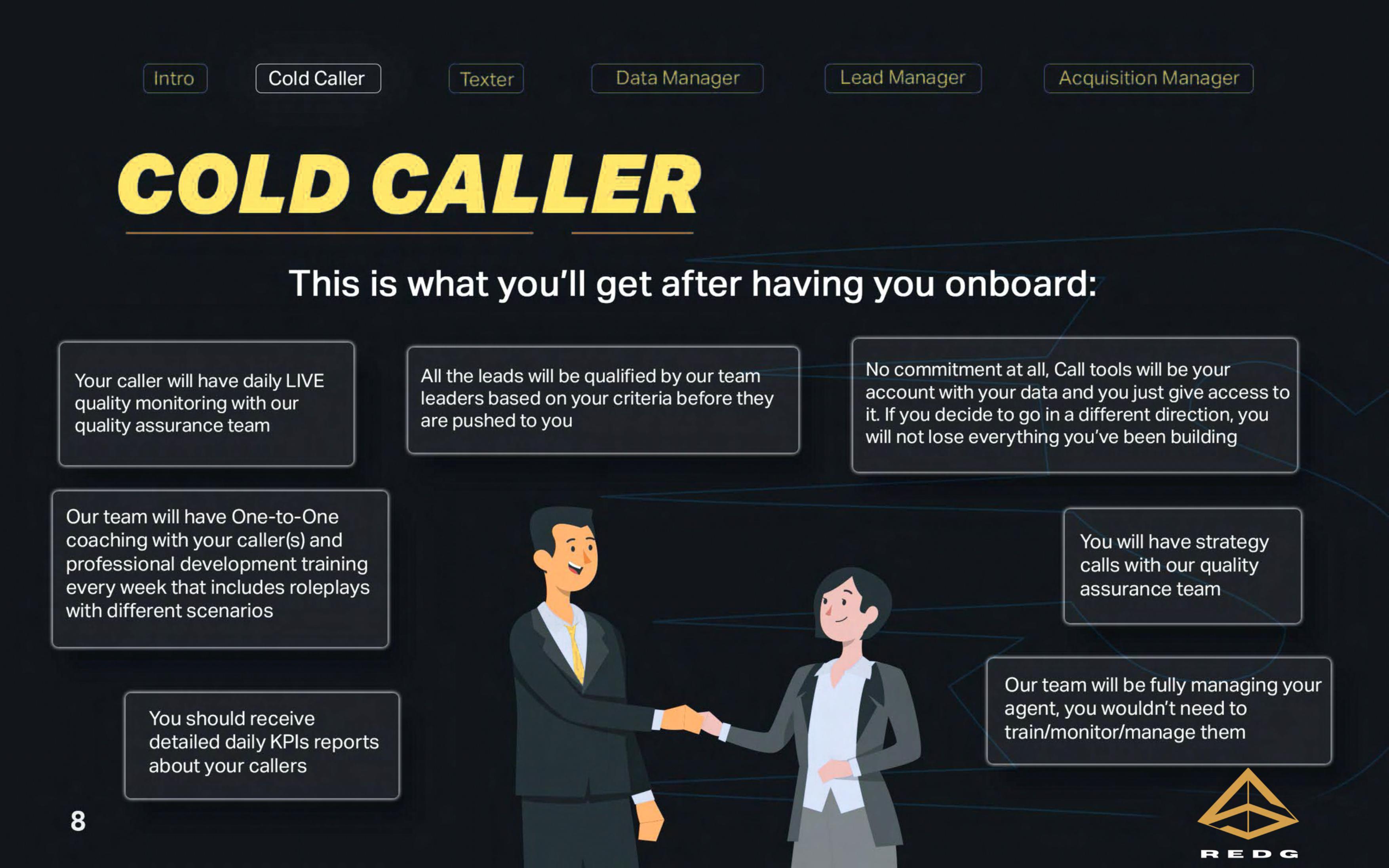
That is why a managed support model can outperform a collection of disconnected freelancers. REDG builds this around one accountable team: trained real estate callers, data support, lead management, and acquisition operations working inside the client’s existing pipeline. The goal is not more CRM activity. The goal is more qualified seller conversations that receive the right next action.
Build the Workflow Before You Buy Features
When comparing acquisition CRM software, investors often focus on automations, dialer integrations, and dashboard design. Those features matter, but they come after the workflow.
Start by mapping what happens to a record from the moment it enters your database. Who verifies the data? Who calls first? What result codes are available? What turns a conversation into a qualified lead? When does a lead move to an acquisition manager? Who follows up after an offer? When does a dead lead return to a long-term nurture campaign?
Once those answers are clear, evaluate software against the work your team actually performs. Look for practical control, not feature overload. The right platform should make it easy to assign records, log calls, schedule follow-ups, track pipeline stages, segment lists, review activity, and export reports without creating extra administrative work.
Be realistic about trade-offs. An all-in-one system may reduce tool sprawl but offer less flexibility in dialing or texting. A highly customizable CRM can match a complex operation but may require more setup and stronger internal discipline. A simpler platform may get a small team running faster, but it can become limiting as lead volume and team roles expand.
The best choice depends on your market count, lead volume, communication channels, and who will manage the system every day. A CRM that looks impressive in a demo but requires constant cleanup is not an operational win.
The Numbers That Reveal Whether It Is Working
A clean pipeline lets you manage output instead of guessing. Do not rely only on the number of leads in the CRM. That number can grow while performance gets worse.
Track the activity that drives the next stage of production. For outbound teams, that includes records worked, connected calls, meaningful seller conversations, qualified leads, appointments or acquisition handoffs, offers, and contracts. Review follow-up completion separately. A team can generate qualified leads and still lose deals by failing to work the nurture pipeline.
Also review conversion by caller, list source, market, campaign, and lead stage. If one caller produces 200 to 300 connected homeowner calls daily but creates no qualified opportunities, inspect call recordings, qualification standards, and list quality. If a campaign generates qualified leads but no offers, the issue may be acquisitions response time or underwriting. If offers go out but contracts do not come back, the negotiation process may need attention.
This is the value of CRM discipline: it gives you a place to find the actual break in the machine.
Set Non-Negotiable CRM Standards
The system only works if the team follows rules that can be audited. Set standards around four areas: every completed call receives a disposition, every qualified lead has complete notes, every live opportunity has a next task and owner, and overdue follow-ups are reviewed daily.
Quality control should include spot-checking records against call recordings. Are callers accurately recording motivation and timeline? Are they tagging leads correctly? Are promised callbacks being scheduled? Are acquisition managers responding fast enough when a lead becomes active?
Do not let the CRM become a graveyard of old records and vague comments. Archive or recycle records with purpose, keep long-term nurture leads on a defined cadence, and require a reason whenever a qualified lead is marked dead. Those habits protect your marketing spend long after the first call is made.
A disciplined acquisition CRM is not about filling dashboards with activity. It is about making sure every seller who gives you a reason to call back receives a professional, timely next step. When that happens consistently, your team stops chasing lost leads and starts building a pipeline that can produce.
Build your calling team
REDG recruits, trains, and manages Egyptian virtual assistants for real estate investors. Explore our real estate virtual assistants, wholesaling VAs, or listen to real calls.