REDG Insights
What a Real Estate Acquisition Manager Owns
REDG Team · · 7 min read

A real estate acquisition manager turns leads into contracts with faster follow-up, clean comps, firm negotiation, and pipeline control and protects deals.
A motivated seller does not become a deal because someone had one good phone call. They become a deal when someone owns the next step, the numbers, the follow-up, and the negotiation. That is the job of a real estate acquisition manager. When this seat is weak, marketing dollars turn into stale leads, vague notes, and opportunities your competitors contract first.
For wholesalers and investors, acquisition is not a title to hand out after a few scripts and a CRM login. It is the revenue-critical function that converts seller intent into signed agreements. The right manager protects speed, margin, and team accountability at the point where all your lead-generation work either pays off or dies.
What a real estate acquisition manager actually owns
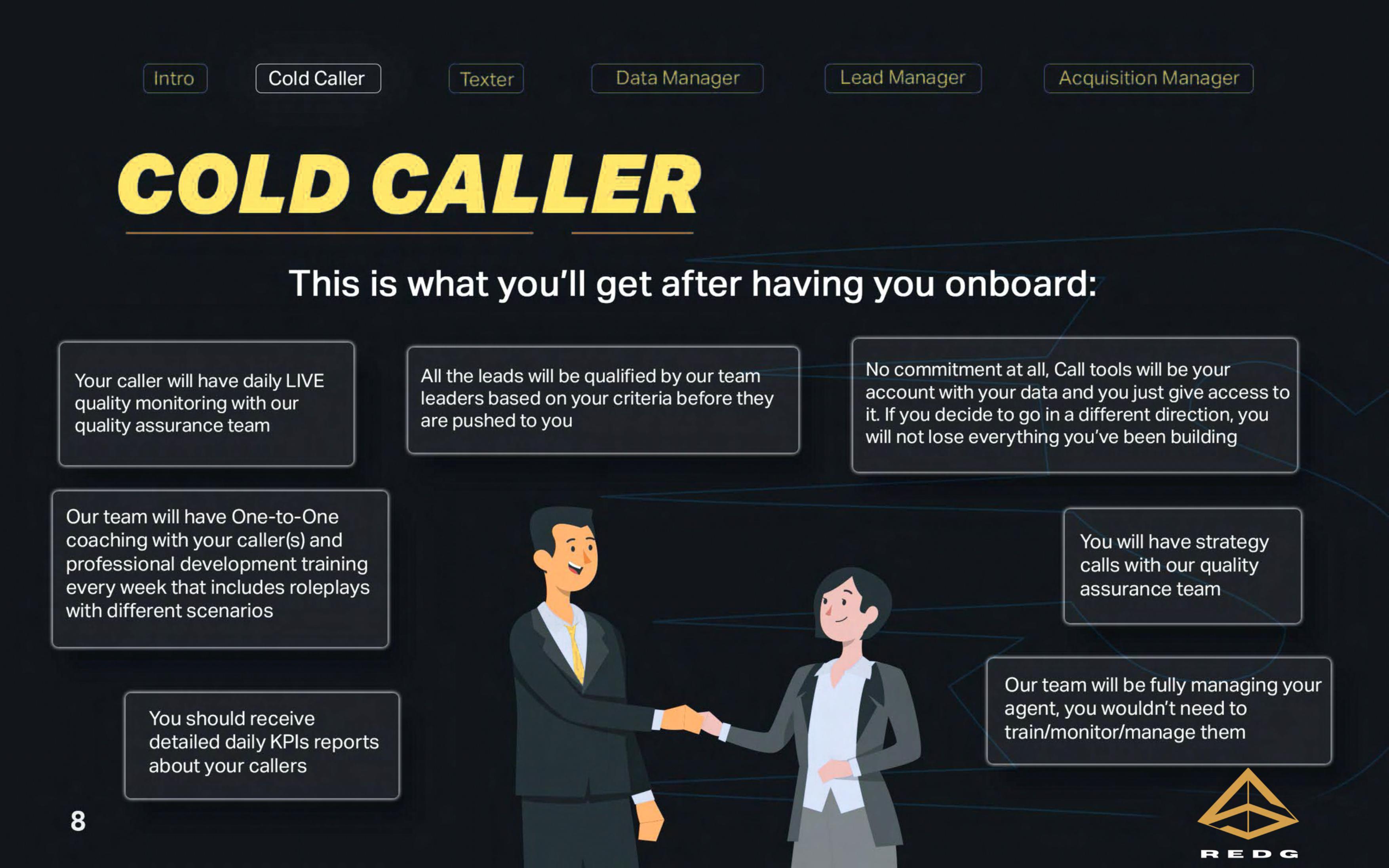
A real estate acquisition manager owns the movement of qualified leads from first meaningful conversation to contract-ready opportunity. That does not always mean they handle every initial call. In a well-built operation, cold callers, SMS texters, and lead managers create and nurture the conversation before an acquisition manager steps in.
Once a seller shows motivation, the acquisition manager takes control. They confirm the property condition, timeline, ownership details, payoff situation, price expectations, and the real reason the seller may transact. They run or verify comps, frame the offer strategy, and decide whether a cash offer, subject-to structure, seller financing, novation, or another path fits the deal.
Most importantly, they create a clear next action. A seller who says, “Call me next week,” is not a follow-up plan. The manager needs a dated task, a reason for the timing, notes another team member can trust, and a specific objective for the next contact.
The role typically owns four production outcomes:
- Speed-to-lead and speed-to-follow-up for every qualified seller
- Accurate property and motivation intelligence inside the CRM
- Offers and negotiations that protect the company’s buy box and margins
- A clean handoff to dispositions, transaction coordination, or the closing team
That ownership is what separates an acquisition operator from a caller who simply passes along a lead.
The work starts before the offer
The biggest acquisition mistakes usually happen before a number is presented. A manager who jumps to “What is the lowest you can take?” without understanding the seller’s situation invites resistance and misses leverage.
A productive conversation establishes the facts first. Is the property vacant or occupied? What repairs are truly needed versus merely cosmetic? Is there a mortgage, tax lien, probate issue, code violation, tenant problem, or pending listing agreement? Why is the seller considering a sale now, and what happens if they do nothing?
The answers change the offer strategy. A tired landlord with a vacant rental may value certainty and speed. An inherited-property seller may need time to coordinate with siblings. A homeowner facing foreclosure may require a solution based on timing, payoff, and communication with the lender. Treating every seller with the same script produces weak information and weaker offers.
The manager also needs to separate stated price from actual motivation. Sellers often name a number because they saw a Zestimate, heard a neighbor’s sale price, or want to test the buyer. That number matters, but it is not the whole deal. Strong acquisition managers ask enough questions to understand whether the seller needs a number, a date, a clean exit, or confidence that the process will not fall apart.
Comping is a decision tool, not a checkbox
Bad comps are expensive. Overestimating after-repair value creates offers that leave no room for rehab, holding costs, buyer fees, or assignment margin. Underestimating value means passing on deals that could have worked.
A capable manager does not just pull nearby sales and call it analysis. They look at property type, square footage, bed and bath count, condition, lot characteristics, market direction, days on market, and the difference between retail buyer demand and investor demand. They also understand the limits of the data. A unique rural property, a mixed-use building, or a house in a rapidly shifting neighborhood may need local agent input or a deeper review before an offer is finalized.
The goal is not to produce a perfect valuation. It is to make a disciplined buying decision with enough margin for the strategy being used. A wholesale offer needs room for the end buyer. A novation needs room for retail prep, commissions, and carrying costs. A creative-finance deal depends on payment terms, equity, loan assumptions, and exit options, not just a discounted purchase price.
That is why an acquisition manager must know the company’s buy box. Without clear criteria, every negotiation becomes an argument over instinct.
Follow-up is where deal flow compounds
Many teams lose deals because they treat lead follow-up as administrative work. It is not. Follow-up is acquisition production.
A seller may be motivated but not ready. They may need to clear out a house, speak with family, wait for a tenant to leave, receive a probate document, or compare your offer with an agent’s opinion. If your team goes quiet after the first conversation, you have paid to create an opportunity for someone else to close.
The manager should build follow-up around the seller’s stated situation, not generic reminders. “Checking in” is weak. “You said your tenant’s lease ends on the 30th. Has your move-out plan changed, and can we walk the property that week?” gives the seller a reason to respond.
This is also where CRM discipline becomes non-negotiable. Every call needs clear notes, a disposition, a next action, and a defined owner. Vague notes such as “seller motivated” or “call back later” create operational fog. Good notes tell the next person exactly what happened, what matters, what objections remain, and when to act.
At REDG, this connected workflow matters because outbound calling, lead management, and acquisition cannot operate as separate islands. A caller can produce 200-300 connected homeowner calls daily, but production only matters when qualified conversations are routed, worked, and followed through by one accountable team.
Negotiation should protect the deal, not just win the call
The best negotiators are not the people who talk the most. They listen for the gap between what the seller says they want and what they need to solve.
A good acquisition manager does not force a low offer before establishing credibility. They explain the buying process clearly, address predictable concerns, and avoid promising terms the company cannot deliver. If a seller needs a certain closing date, the manager confirms whether title, funding, inspections, and decision-makers can support it. If the seller wants a higher price, the manager can discuss what conditions would need to change for that number to work.
There is a trade-off here. Speed matters, especially in competitive markets, but rushed agreements often create fallout. A manager who skips title questions, repair verification, spouse or heir involvement, and expectation-setting may get a signed contract that never closes. A slightly slower, better-qualified agreement is usually worth more than a fast contract with hidden problems.
Objection handling should also be honest. “I need to think about it” might mean price resistance, distrust, family pressure, or a genuine need for time. The manager’s job is to identify which one it is, not bury it under a rehearsed rebuttal.
How to measure acquisition performance
Contracts alone are not enough to evaluate an acquisition manager. One lucky deal can hide poor process, while a manager working complex leads may create valuable pipeline that takes longer to convert.
Track the full production chain: qualified leads received, contact rate, appointments held, offers made, contracts signed, contract-to-close rate, average projected margin, and average days from qualification to contract. Review fall-through reasons as aggressively as wins. If deals repeatedly die because of bad comps, unclear seller expectations, missing decision-makers, or weak title screening, the operation has a process problem.
Call reviews matter too. Managers should be evaluated on discovery, control of the conversation, objection handling, offer presentation, and next-step clarity. Proof beats promises. Recorded calls and CRM records show whether the work is actually happening.
The right KPI mix depends on your market, lead source, and strategy. A team buying distressed off-market cash deals will not have the same cycle time as a team pursuing creative-finance opportunities. But every team should be able to answer a basic question: where do qualified sellers stall, and who owns fixing it?
Build the seat before you hire the title
If you are hiring for this role, define the handoffs first. Decide what qualifies a lead for acquisition, what information must be collected before transfer, when the manager can make an offer, who approves exceptions, and what happens after a verbal agreement. Then build scorecards around those standards.
Do not hire someone solely because they sound confident on the phone. Look for evidence of comping judgment, CRM discipline, real follow-up habits, and the ability to negotiate without inventing promises. The role requires commercial instinct, but it also requires process discipline.
Your acquisition manager should make the rest of your operation easier to trust. When every lead has a clear status, every seller has a next step, and every offer matches the buy box, your marketing spend starts producing a pipeline you can scale instead of a pile of conversations to chase.
Build your calling team
REDG recruits, trains, and manages Egyptian virtual assistants for real estate investors. Explore our real estate virtual assistants, wholesaling VAs, or listen to real calls.