REDG Insights
How to Generate Novation Real Estate Leads
REDG Team · · 7 min read

Get more novation real estate leads with targeted lists, trained seller conversations, disciplined follow-up, and clear exit-plan qualification at scale.
A seller can have plenty of equity, a house that needs little work, and a price that makes a standard cash offer impossible. That does not make the lead dead. It may be exactly the kind of conversation that creates novation real estate leads - if your team can identify the right conditions, explain the structure clearly, and follow up before another investor gets there.
Novation is not a replacement for wholesale acquisitions. It is an additional exit path for sellers whose property has retail appeal but whose price expectations leave no room for a traditional assignment. The opportunity is real, but so is the operational burden. Weak data, vague qualification, poor CRM notes, and inconsistent follow-up will turn a promising novation conversation into another wasted marketing dollar.
What Makes a Novation Lead Different?
A novation lead is not simply a homeowner who wants close to retail value. The structure works when the seller needs a solution, has enough equity or payoff flexibility, and owns a property that can reasonably compete on the retail market after any necessary preparation.
In practical terms, the lead sits between a conventional motivated-seller deal and a listing opportunity. The seller may want speed, certainty, help with repairs, or an alternative to putting the home on the market themselves. Your acquisition team needs to determine whether the property can be sold to an end buyer at a price that supports commissions, closing costs, repair exposure, holding costs, and your required margin.
That means a caller cannot treat novation as a script-only offer. They need to uncover the seller's reason for selling, timeline, property condition, mortgage balance, price expectation, and willingness to consider a structured sale. Then an acquisition manager must run the numbers before anyone makes promises.
The trade-off is straightforward: novation opportunities can produce larger spreads than a thin wholesale assignment, but they require tighter underwriting, cleaner communication, and more hands-on transaction management. They are not the right solution for every seller or every market.
Build Lists for Novation Real Estate Leads
The best novation campaigns start with lists that create retail potential and seller motivation at the same time. Pulling every absentee owner in a county and hoping callers find the right fit is expensive. Your data strategy should narrow the field before the first dial.
Look for owners whose properties are likely to appeal to retail buyers, particularly in stable owner-occupant neighborhoods. Equity matters, but it should not be the only filter. A homeowner with strong equity who has no urgency may simply list with an agent. A seller with moderate equity, a clean property, and a clear need for a low-friction sale may be a stronger candidate.
Useful list segments often include high-equity absentee owners, inherited properties, vacant homes, long-term owners, tired landlords, code-violation records, and expired listings where permitted by your data and outreach practices. Pre-foreclosure can also work, but timing is critical. If the seller needs an immediate resolution, you need a team that can evaluate the file quickly and communicate realistic options.
Layer your lists by neighborhood price point and retail demand. A property that appears attractive on paper can still be a poor novation candidate if local days on market are rising, buyer demand is weak, or comparable sales do not support the seller's expectation. Data managers should verify ownership, skip-trace accurately, remove duplicates, and tag records by campaign before outreach begins. Bad records create bad call volume. There is no workaround for that.
Qualify the Seller Before You Pitch the Structure
The first call should earn information, not force a novation explanation too early. Homeowners rarely respond well to jargon, and most do not care whether your exit is an assignment, a novation, or a creative finance structure. They care about their price, timing, condition, and certainty.
A trained caller should establish rapport, confirm the property details, and identify the seller's actual problem. Is the home listed? Do they need repairs they cannot afford? Are they relocating? Is there a tenant, estate issue, lien, or mortgage payoff that affects the decision? These details determine whether the lead moves forward.
Before the lead reaches acquisitions, your team should capture five non-negotiables:
- The seller's reason for selling and required timeline
- Their price expectation and flexibility around net proceeds
- Property condition, repair scope, and occupancy status
- Mortgage balance, liens, and equity position
- Their openness to a sale process that may target a retail end buyer
The wording matters. Do not tell a seller you can get them an unrealistic number just to secure an appointment. That creates distrust later and wastes your acquisition manager's time. Position the conversation honestly: your team may have more than one way to help, but the numbers and property condition must support the solution.
This is where many teams lose deals. Callers mark a lead as motivated because the owner wants to sell, while the CRM contains no useful notes about payoff, repairs, timeline, or price. Acquisitions then starts from zero. A qualified novation lead should arrive with a clear seller story, not a vague tag and a phone number.
The Follow-Up System Is Where the Margin Lives
Most sellers will not commit on the first call. They may be comparing options, talking to family, waiting for a tenant to leave, or hoping the market delivers a better offer. If your follow-up stops after one conversation, you are paying to generate leads for competitors who stay organized.
Every novation prospect needs a next action, an owner, and a date. The caller may need to reconnect after the seller gathers payoff information. A lead manager may need to request photos or confirm access. An acquisition manager may need to present the offer structure after reviewing comps and estimated costs. Each handoff must be visible in the CRM.
Use call notes that let the next person continue the conversation without making the seller repeat themselves. Record condition details, stated objections, family decision-makers, price movement, and the exact reason for the next follow-up. A note that says "call back next week" is not lead management. A note that says "seller expects $315,000, owes approximately $188,000, roof is 12 years old, daughter is helping decide, wants to move after school ends June 3" gives your team a real operating plan.
Texting can support the process, but it should not replace meaningful phone follow-up. A short, compliant text confirming an appointment or asking for photos can keep momentum. The conversion work still happens when a qualified person can answer questions, handle concerns, and move the seller toward a decision.
Underwrite the Exit, Not Just the Lead
A lead becomes a novation opportunity only after the math holds up. Your acquisition manager needs a disciplined review of realistic resale value, repair and preparation costs, anticipated agent commissions, closing costs, carrying costs, buyer demand, and the seller's required proceeds.
Be conservative. A hopeful after-repair value can make any deal look attractive. The real question is whether the property can sell within a reasonable period at a price supported by actual comparable sales and local demand. If the spread disappears once you use realistic costs, it is not a novation deal. It may still be a listing referral, a cash offer opportunity, or a lead worth nurturing, but it should not consume your transaction team's capacity.
Your agreement and disclosures should also be reviewed by qualified local legal and brokerage professionals. Novation transactions involve state-specific rules, licensing considerations, contract language, advertising practices, and disclosure requirements. Operational discipline does not replace legal compliance.
Assign Clear Roles From Data to Contract
Novation deals break down when everyone touches the lead but nobody owns the outcome. The best acquisition operations create a defined chain of responsibility: data management builds and cleans the list, callers create qualified conversations, lead managers control follow-up, acquisition managers underwrite and negotiate, and transaction support keeps the file moving once the seller agrees.
This is why generic virtual assistant staffing often disappoints investors. A person who can dial a phone is not automatically equipped to recognize a novation fit, document a seller's situation, or protect an acquisition team's calendar. You need people trained around real estate scenarios, objection handling, CRM standards, and daily activity expectations.
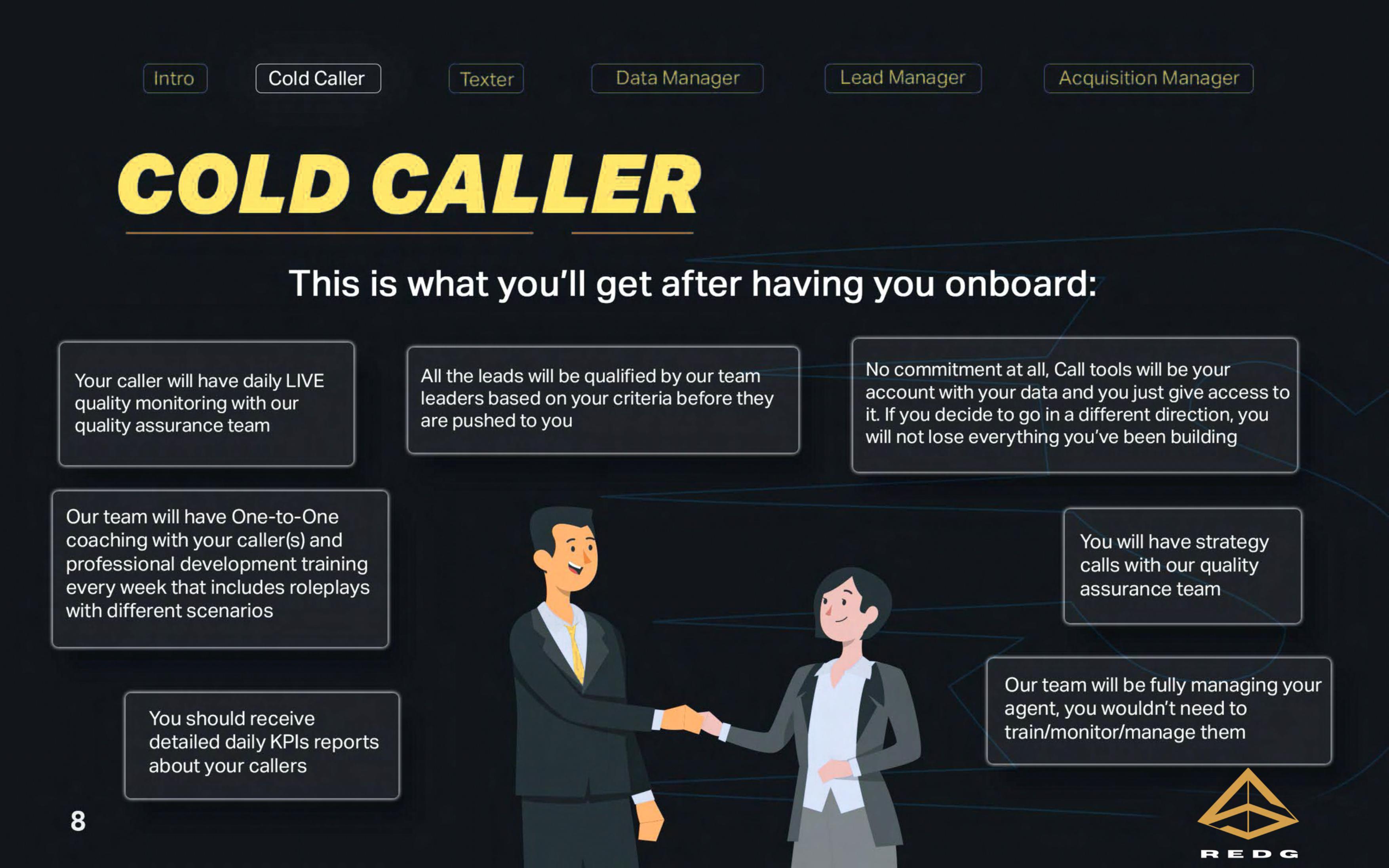
REDG is built around that production model: real-estate-specific callers, data support, lead management, and acquisition operations working as one accountable team. The objective is not more random conversations. It is cleaner seller intelligence, faster handoffs, and a pipeline your team can trust.
Track the metrics that reveal whether the campaign is actually producing. Connected calls and conversations matter, but they are early indicators. Watch qualified leads by list, appointments set, follow-up completion rate, acquisition review rate, offers made, and contracts generated. Then compare performance by market, list type, caller, and lead source. That is how you find the campaigns worth scaling and cut the ones that only create activity.
Do Not Force Every Seller Into a Novation
The strongest operators keep multiple paths available. Some sellers need a cash offer because speed matters more than price. Some need a conventional listing because the property is retail-ready and they can wait. Some fit a creative finance structure. Others are simply not motivated enough yet.
Treat novation as a precise tool, not a magic label. When your data, callers, follow-up process, and underwriting are aligned, it gives your team another way to convert leads that a standard wholesale offer would miss. Start by tightening the information you collect on every seller conversation. Better questions today create better exits when the right homeowner answers tomorrow.
Build your calling team
REDG recruits, trains, and manages Egyptian virtual assistants for real estate investors. Explore our real estate virtual assistants, wholesaling VAs, or listen to real calls.