REDG Insights
Egyptian Real Estate Cold Callers Who Produce
REDG Team · · 6 min read

Egyptian real estate cold callers give U.S. investors disciplined outreach, qualified seller conversations, and accountable pipeline follow-up at scale.
A cold-calling seat is not valuable because someone is dialing. It is valuable when it turns a difficult homeowner conversation into a clean next action your acquisition team can trust. Egyptian real estate cold callers can fill that role effectively for U.S. investors, but only when they operate inside a managed acquisition system with clear standards, real estate training, and daily accountability.
The alternative is familiar: a caller burns through a list, logs vague notes, promises a callback that never happens, and leaves your team paying for data and skip tracing without getting closer to a contract. That is not a staffing problem alone. It is a production-control problem.
Why Egyptian Real Estate Cold Callers Fit Acquisition Teams
Egypt has a deep talent pool of college-educated professionals with strong English skills, experience working with U.S. businesses, and the ability to work schedules that overlap with American calling windows. For a wholesaler or investor, the advantage is not simply lower labor cost. It is the ability to build more consistent outbound capacity without adding the full overhead of an in-house calling department.
That distinction matters. Cheap calling can be expensive when the caller cannot build rapport, does not understand seller motivation, or fails to document the conversation correctly. A homeowner who says, “I might consider selling after I speak to my brother,” is not a dead lead. It is a follow-up opportunity that needs a date, a reason, and a clear task in the CRM.
Well-trained Egyptian callers can handle the front end of this process: opening the conversation, confirming ownership, uncovering property condition and timeline, identifying price expectations, and setting a next step. They can also manage common resistance without sounding scripted. The goal is not to force a seller into a decision. The goal is to identify real motivation and move qualified conversations forward.
Calling Volume Only Matters When Quality Holds
High activity standards matter in off-market acquisition. A productive caller may complete 200 to 300 connected homeowner calls per day, depending on the campaign, list quality, dialer, territory, and what your team counts as a connection. But volume alone is a vanity metric if the data entering your pipeline is unusable.
A good operation measures the full chain, not just dials. That means tracking contacts, meaningful conversations, qualified leads, appointments or acquisition handoffs, follow-up tasks completed, and eventual contracts. If one caller produces a large number of “leads” but the acquisition manager cannot reach them, cannot find the notes, or learns the seller was never motivated, the calling report is hiding a problem.
The strongest callers work from a defined qualification framework. They know which details must be captured before a lead is passed forward: property address, ownership confirmation, occupancy, condition, motivation, timeline, price expectations, mortgage or lien context when available, and the seller’s preferred next step. Not every conversation will reveal every detail. The standard is to record what was actually said, not manufacture certainty to make a dashboard look better.
The Caller Should Not Be Left to Interpret the Entire Deal
Cold callers are a critical production role, but they are not replacements for experienced acquisition managers. A caller should qualify and advance the conversation. An acquisition manager should handle deeper discovery, offer positioning, negotiation, creative-finance discussions, and contract conversion.
This separation protects your pipeline. It gives sellers a responsive first point of contact while allowing your closer to spend time on conversations with real potential. It also prevents an expensive bottleneck where the owner or lead acquisition manager spends hours sorting through poorly documented callbacks.
What a Managed Calling Workflow Looks Like
The caller’s performance depends on what happens before and after the call. A strong process starts with targeted list selection and clean data. Whether you are calling absentee owners, inherited properties, pre-foreclosure records, tired landlords, high-equity owners, or a niche list in one market, the campaign needs a clear purpose and a contact strategy.
After list pulling and skip tracing, the calling team works from an approved script and objection framework tailored to your market and exit strategy. The script provides control, but it cannot be a rigid recital. Homeowners respond to people, not readouts. The caller needs enough real estate fluency to explain why they are calling, ask direct questions, and keep the conversation professional when the seller is skeptical.
Every call then produces a disposition. Wrong number, do-not-call request, not interested, warm follow-up, qualified lead, or appointment each requires a defined CRM action. Notes should be specific enough that the next person can continue the conversation without asking the seller to repeat everything. Follow-up dates must be assigned, not implied.
For qualified opportunities, the handoff should be fast. A seller who agrees to speak with an acquisition manager today should not receive a callback next week. Speed-to-lead is part of conversion, particularly with owners who are speaking to several buyers. The calling team, lead manager, and acquisition manager need shared rules for urgency, handoff method, and ownership of the next action.
Quality Control Is the Difference Between Help and Headaches
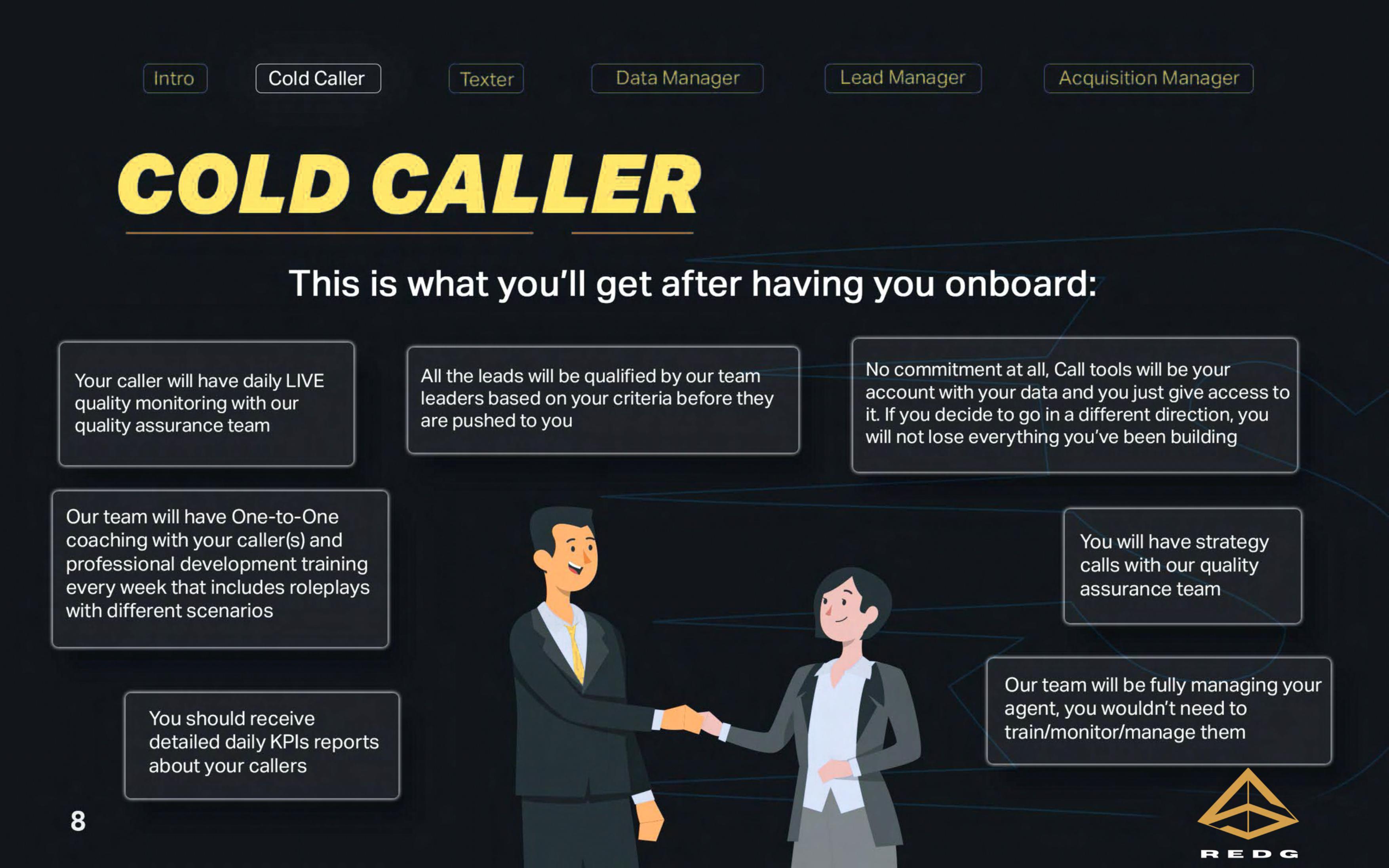
You should never have to guess whether your caller is professional, clear, or accurate. Recorded calls, live monitoring, coaching notes, and KPI reviews create proof of performance. They also reveal where the issue actually sits.
Sometimes the caller needs coaching on objection handling or tone. Sometimes the list is weak, the skip tracing is outdated, or the offer criteria are too narrow for the market. A managed team can identify these patterns early because it reviews both activity and outcomes. A generic VA arrangement often cannot, because it treats the assignment as completed once calls are made.
At REDG, this is the operating principle: one accountable team should own the work from data through seller conversation and pipeline action. That does not mean your team gives up control. It means you gain visibility into who is working, what they are producing, and where the process needs correction.
Where Investors Get It Wrong
The most common mistake is hiring on price alone. A low hourly rate looks efficient until the caller mispronounces basic terms, cannot handle a simple objection, or creates a CRM full of incomplete notes. The real cost is not the hourly rate. It is the wasted list, the missed follow-up, and the acquisition time spent repairing avoidable damage.
The second mistake is expecting a caller to solve a broken acquisition process. No caller can compensate for unclear targeting, no lead definitions, slow follow-up, or a CRM that nobody owns. If your acquisitions team does not agree on what qualifies as a lead, callers will either pass too much noise or hold back opportunities that deserve attention.
The third mistake is ignoring compliance. U.S. outbound calling requires disciplined handling of internal do-not-call requests, calling-time rules, and any applicable federal, state, and local requirements. Your service provider should follow your approved processes, document opt-outs immediately, and avoid improvised tactics that create avoidable risk. Compliance is operational discipline, not an afterthought.
How to Evaluate a Caller Before You Commit
Do not evaluate Egyptian cold callers based only on an interview and a claimed accent level. Ask to hear recorded calls. Review their notes after a seller conversation. Test whether they can identify motivation, distinguish curiosity from urgency, and set a precise follow-up action.
Then look at the management layer. Who monitors calls? How quickly can a weak script or data issue be identified? What KPIs are reported daily or weekly? How are callers coached? Can you add supporting roles such as data management, lead management, SMS outreach, or acquisition support as volume grows?
The right answer depends on your business. A solo wholesaler working one county may need one caller and a disciplined lead follow-up process. A multi-market operation may need a coordinated pod of callers, data specialists, texters, and acquisition managers. In both cases, the standard remains the same: every activity should create a measurable next step toward a seller conversation or a contract opportunity.
Your outbound team should not be a black box that consumes lists and produces excuses. Give capable callers a clear process, inspect the work, and build the handoff around speed and accountability. That is how a calling seat becomes a dependable part of your acquisition engine.
Build your calling team
REDG recruits, trains, and manages Egyptian virtual assistants for real estate investors. Explore our real estate virtual assistants, wholesaling VAs, or listen to real calls.