REDG Insights
Absentee Owner Calling Service That Produces
REDG Team · · 6 min read

An absentee owner calling service should turn skip-traced records into qualified seller conversations, tracked follow-up, and real acquisition opportunities.
An absentee owner calling service is not a person reading a script through a random list. It is a production system that identifies likely sellers, reaches the right owners, qualifies real motivation, and keeps every next step moving. When that system breaks at any point - weak data, poor English, missed notes, or no follow-up - your acquisition team pays for it in lost contracts.
Absentee owners can be one of the most productive off-market segments because they already have distance from the property. Some are tired landlords. Some inherited a house they do not want to manage. Some live out of state, own a vacant property, or have equity tied up in a rental that no longer fits their plans. But absentee status is not motivation. The work is separating a useful conversation from a dead record without burning through your list or wasting your closers' time.
What an Absentee Owner Calling Service Must Deliver
A calling service earns its place in your operation when it creates visibility and forward motion. Your acquisition manager should not be asking what happened to yesterday's leads. They should see who was contacted, what the owner said, how motivated they are, what condition the property is in, and exactly when the next follow-up is due.
That starts before the first dial. A productive campaign needs a defined market, clean ownership records, property filters that match your buy box, current phone data, and a clear disposition plan for each call outcome. Calling a broad absentee list without those controls creates volume, not opportunity.
The caller's job is equally specific. They need to confirm ownership, establish whether the owner would consider selling, uncover the reason behind that decision, and gather details that affect the offer. Timeline, price expectations, property condition, tenancy, mortgage situation, and decision-maker availability all matter. A vague note that says “interested” is not a qualified lead. It is a future problem for the person expected to close it.
A real-estate-trained caller also knows when to stay curious and when to exit. An owner who says, “Maybe someday,” may need a scheduled nurture follow-up. An owner demanding retail price for a fully renovated home in a market you do not buy is not a hot lead just because they stayed on the phone. Qualification protects your acquisitions team from chasing conversations that cannot become deals.
The Workflow Behind Consistent Absentee Owner Calls
Reliable results come from a connected workflow, not isolated calling activity. The list, skip trace, caller, CRM, lead manager, and acquisition manager must operate as one accountable team.
Start with a list built for your actual strategy
Not every absentee owner belongs in the same campaign. A landlord with one inherited rental is different from an LLC with 40 doors. An out-of-state owner with high equity may fit a cash offer conversation, while a long-term owner with a low-rate loan may be better suited to creative finance. Segmenting the data gives callers a relevant opening and gives your team cleaner reporting.
Filters should reflect the deals you can actually close. Depending on your market, that may include ownership length, equity, vacancy indicators, property type, mailing address distance, tax delinquency, code violations, or recent eviction activity. More filters are not automatically better. Over-filtering can shrink a viable market, while under-filtering forces callers to spend time on records that were never a fit.
Then verify the contact information. Skip tracing is not a one-time checkbox. Phone data degrades, relatives get attached to records, and numbers are reassigned. A data manager should track contact rates and flag list sources or segments that consistently underperform.
Call with control, not a rigid script
The opening matters, but it is not the whole call. Strong callers sound professional, clear, and comfortable speaking with U.S. homeowners. They introduce the purpose of the call honestly, confirm they have the right person, and ask permission to continue. From there, they listen for the owner's situation instead of trying to force every answer into a script.
Objections are where generic callers fail. “I'm not interested” can mean the owner truly wants to hold, does not trust the call, recently received a bad offer, or simply does not have time. The caller needs to respond calmly, ask a useful follow-up question, and recognize when not to push. Pressure may win another 30 seconds of talk time while damaging the chance of a future deal.
A disciplined caller records the conversation while it is fresh. Property condition, tenant status, motivation, price, timing, and objections should be logged in structured CRM fields, with a plain-English summary for the closer. Call recordings and regular quality checks make this auditable. You can coach a caller from evidence, not from assumptions.
Route leads based on urgency and fit
Speed-to-lead matters most after an owner gives a real signal. A seller with an immediate problem, a defined timeline, and reasonable expectations should move quickly to an acquisition manager. A lead with interest but no near-term decision should enter a scheduled follow-up sequence. A wrong number, hostile contact, or clear non-fit should be coded correctly so it does not keep draining call capacity.
This is where many teams lose the value of their calling spend. The caller gets a motivated response, but the CRM is incomplete, the notification is missed, or nobody follows up until days later. The owner has already spoken with another investor by then. The handoff must be owned, measured, and fast.
The KPIs That Expose Weak Calling Operations
Do not judge a calling partner only by dials. Dial counts can be inflated by poor numbers, unanswered calls, and low-effort activity. You need KPIs that show whether the campaign is creating qualified seller conversations.
Track contact rate, meaningful conversations, qualified leads, appointment or acquisition handoffs, follow-up completion, and lead-to-contract performance over time. Review results by list segment, caller, market, and lead source. That tells you whether the problem is data quality, caller execution, offer strategy, or acquisitions follow-through.
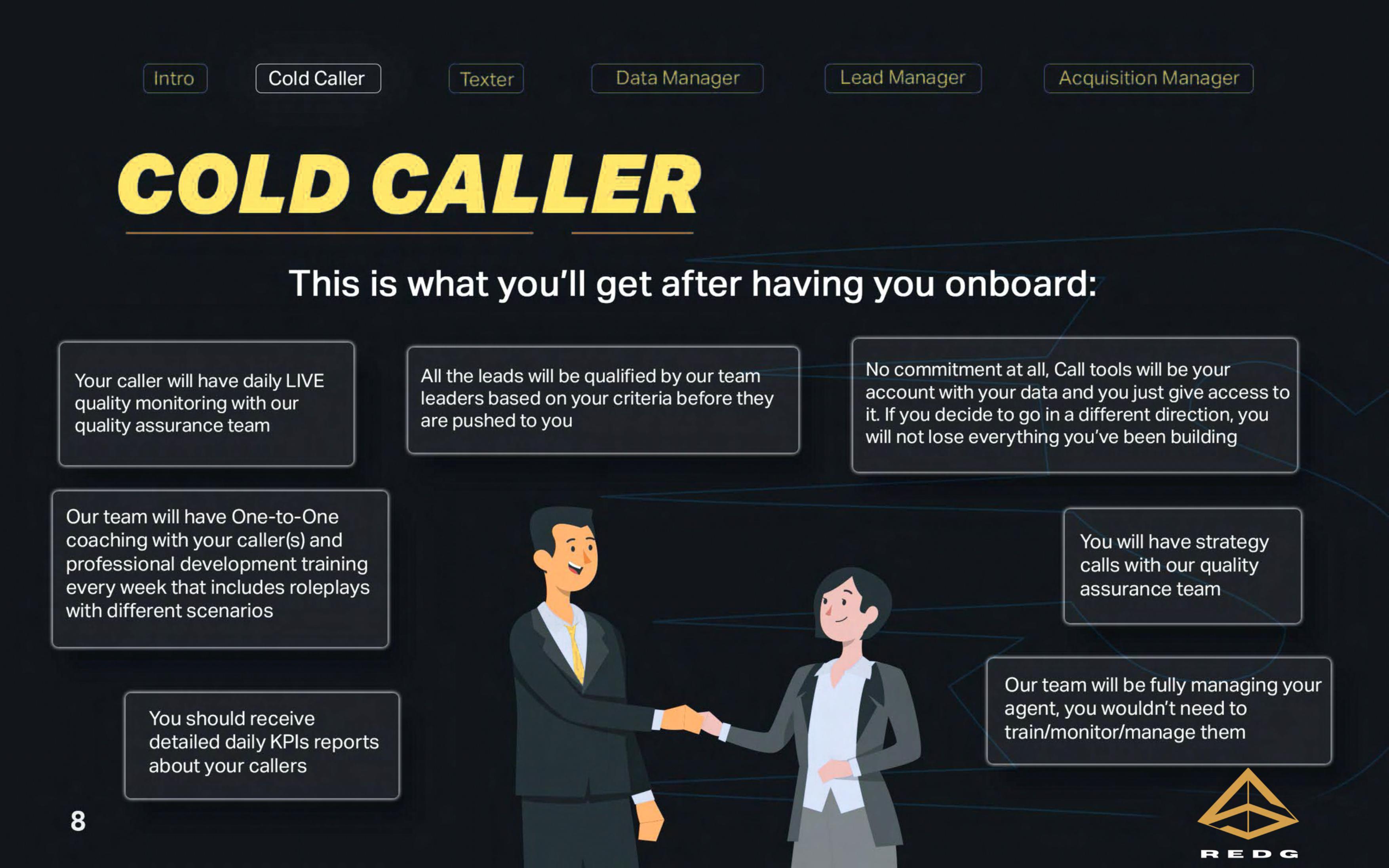
Daily standards matter as well. REDG's calling model is built around 200-300 connected homeowner calls daily, with live quality monitoring, recorded samples, and KPI oversight. The number alone is not the point. Consistent production only matters when the conversations are correctly qualified and documented for the next person in the workflow.
Ask to see how quality is managed. Are callers reviewed against a scorecard? Are they coached on objection handling and note quality? Can you hear recorded call samples? Is there a defined process for replacing a caller who cannot meet standards? If the answer is vague, expect vague results.
Compliance Is Part of Production
Absentee owner outreach carries real compliance obligations. Your calling process should respect federal and state rules, internal do-not-call procedures, calling-time restrictions, and any consent requirements that apply to your dialing methods and messages. Laws and interpretations change, so your business should use qualified legal counsel to establish the policies appropriate for its markets and technology.
Operationally, that means maintaining suppression processes, honoring opt-outs immediately, documenting call outcomes accurately, and training callers not to make misleading claims. Compliance is not a separate task for later. It protects your reputation, your list quality, and your ability to keep marketing in the same market.
When Outsourcing the Calls Makes Sense
An absentee owner calling service is a strong fit when your team has a repeatable acquisition process but lacks the daily capacity to work lists consistently. It also makes sense when your internal callers are producing uneven notes, weak qualification, or poor follow-up discipline.
It is not a substitute for a broken business model. If your offers are not competitive, your lead manager does not respond, or your market has no defined buy box, adding callers will multiply confusion. Get the workflow clear first, then add trained calling capacity to execute it every day.
The right partner should fit into your existing pipeline rather than force you into a disconnected process. They should understand real estate language, report activity clearly, and take responsibility for the pieces they own. That is the difference between hiring cheap labor and building a dependable acquisition engine.
Your absentee list is not valuable because it has thousands of names. It becomes valuable when every legitimate conversation gets the right next action, on time, with no ambiguity about who owns it.
Build your calling team
REDG recruits, trains, and manages Egyptian virtual assistants for real estate investors. Explore our real estate virtual assistants, wholesaling VAs, or listen to real calls.